

Clean Code Best Practices
Introduction
Writing code is easy, but writing clean code is what makes you a professional developer.
Clean code is not just about making your program work. It is about writing code that is easy to read, easy to understand, and easy to maintain in the long run.
When you or another developer looks at your code after a few months, it should still be clear and simple without any confusion.
In this blog, you will learn clean code best practices, along with a real developer mindset that is used in modern software development.
What is Clean Code?
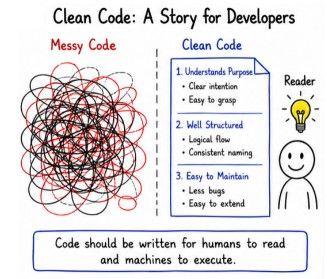
Clean code means writing code in a way that is clear, simple, and easy for humans to understand.
It is code that is written not just for the computer, but for other developers who will read and work on it in the future.
A clean code follows these basic qualities:
Easy to read – Anyone can understand it quickly
Easy to modify – Changes can be made without breaking things
Fewer bugs – Well-structured code reduces errors
Proper structure – Organized and logically written
👉 In simple words: Clean code = Human-friendly code that is easy to read, maintain, and scale
Why Clean Code is Important?
Many beginners focus only on making the code work, but ignore how the code is written. In real-world software development, this leads to messy and hard-to-manage code.
When code is not clean, it creates serious problems such as:
Hard to debug errors and fix issues quickly
Difficult collaboration in team projects
Slower development and feature delivery
Increased technical debt over time
👉 That’s why top tech companies like Google, Amazon, and Microsoft always prefer developers who write clean, readable, and maintainable code.
Clean code helps teams work faster, reduces bugs, and makes large projects easier to manage in the long run.
Clean Code Best Practices
Now let’s understand the most important clean code rules that every developer should follow to write professional and maintainable code.
1. Use Meaningful Names
One of the most important rules of clean code is using clear and meaningful names for variables, functions, and classes.
Bad code:
int a = 10;Good code:
int userAge = 10;👉 Variable names should clearly explain what the data represents, instead of confusing the person reading the code.
Good examples:
userName
totalPrice
isActive
Avoid unclear names like:
x, y, z
a1, data1
temp, value (without context)
👉 Simple rule: If someone else reads your code, they should understand it without guessing.
2. Keep Functions Small
A function should do only one task at a time.
When a function handles too many things, it becomes hard to read, test, and maintain.
Bad: One function handling login, validation, and database saving together
Good: Separate functions for each task like login(), validateUser(), saveToDatabase()
👉 Rule:
One function = One responsibility
👉 Simple idea: If a function is doing more than one job, split it into smaller functions.
3. Remove Duplicate Code (DRY Principle)
DRY stands for Don’t Repeat Yourself.
If you write the same code again and again in multiple places, it becomes difficult to manage and update later.
Bad practice: Writing the same logic multiple times in different parts of the code
Good practice:
Create reusable functions
Use helper methods or common utilities
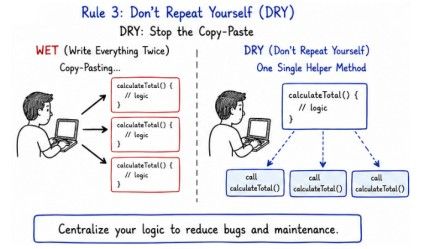
Benefit:
When you need to change logic, you only update it in one place, and it reflects everywhere.
👉 Simple rule: Write once, use everywhere.
4. Write Simple Code (KISS Principle)
KISS stands for Keep It Simple, Stupid.
The idea is simple: don’t make your code more complex than it needs to be.
Bad practice: Using complex loops and deeply nested conditions that are hard to understand
Good practice:
Use simple if-else logic
Keep the flow of code clear and easy to follow
👉 Simple rule: Simple code is always better than smart but confusing code.
5. Proper Formatting & Indentation
Clean code is not just about logic — it is also about how the code looks visually.
When your code is properly formatted, it becomes much easier to read and understand.
Follow these rules:
Use proper spacing between lines
Maintain consistent indentation
Keep brackets and blocks well aligned
Good formatting makes your code look clean, structured, and professional.
👉 Simple idea: Well-formatted code reads like a clear story instead of a messy paragraph.
6. Avoid Hardcoded Values
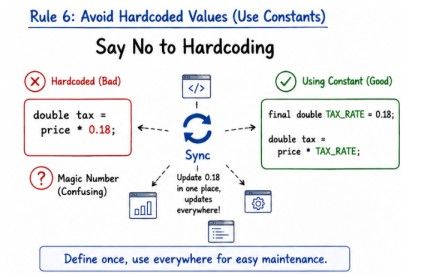
Hardcoding means directly writing fixed values inside your code. This makes the code hard to update later.
Bad code:
double tax = price * 0.18;Good code:
final double TAX_RATE = 0.18;
double tax = price * TAX_RATE;
Hardcoded values make code difficult to maintain because if the value changes, you have to update it in many places.
👉 Simple rule: Always use constants instead of fixed values in your code.
7. Write Self-Explanatory Code
Your code should be clear enough that it explains itself without needing extra comments.
Avoid unnecessary comments like:
// increment i by 1
i++;
Instead, write code that is already easy to understand:
i++;Good code should be readable just by looking at it. If you need to explain every line with comments, it means the code is not clean enough.
👉 Simple rule: Code should speak for itself, comments should be used only when really needed.
8. Follow Consistent Naming Convention
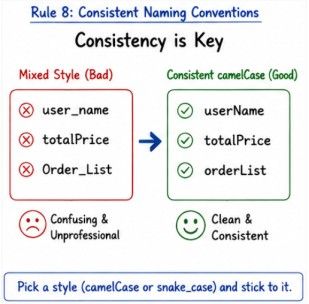
In clean code, consistency is very important. You should always follow the same naming style throughout your project.
Choose one naming style and stick to it:
camelCase → used in Java, JavaScript
snake_case → commonly used in Python
Example:
userName, totalPrice (camelCase)
user_name, total_price (snake_case)
Why it matters:
When you use a consistent style, your code becomes easier to read, understand, and maintain—especially in large projects or team environments.
👉 Simple rule: Don’t mix different naming styles in the same project.
9. Follow SOLID Principles (Basic Idea)
SOLID is a set of design principles that helps you write clean, scalable, and maintainable code.
It is widely used in professional software development.
S → Single Responsibility Principle
O → Open/Closed Principle
L → Liskov Substitution Principle
I → Interface Segregation Principle
D → Dependency Inversion Principle
👉 Don’t worry about the deep theory right now. Just understand this simple idea:
Good code should be flexible, easy to extend, and easy to maintain without breaking existing features.
10. Refactor Regularly
Clean code is not something you write once and forget — it is something you continuously improve over time.
Always:
Remove unused or unnecessary code
Optimize and simplify your logic
Improve variable and function names
Why it matters:
Refactoring keeps your code clean, faster, and easier to maintain as the project grows.
👉 Simple rule: Good developers don’t just write code — they keep improving it.
Benefits of Writing Clean Code
If you follow clean code practices in your projects, you will see a big improvement in your development skills and overall code quality.
You become a better and more professional developer
Your code becomes production-ready and industry standard
Team collaboration becomes easier and smoother
Debugging becomes faster and less stressful
You get better job opportunities in top companies
👉 Simple idea: Clean code saves time, reduces errors, and helps you grow faster as a developer.
Final Thoughts
Clean code is not just a skill — it is a professional habit that every developer should build over time.
If you want to become a good software developer or backend engineer, you should start focusing on writing clean and readable code from today itself.
👉 Remember:
Code is written for humans first, computers second.