
Durgesh Tiwari
Author
As software applications grow, they need to handle more users, process larger amounts of data, and support frequent updates. A simple architecture may work for small applications, but it often becomes difficult to maintain and scale as the application grows.
This is where Modern Software Architectures become important. They divide an application into smaller, well-defined components, making it easier to develop, maintain, scale, and deploy. They also allow multiple teams to work independently on different parts of the application.
In this section, you'll learn popular modern software architectures, including Microservices Architecture, Event-Driven Architecture, Serverless Architecture, Clean Architecture, Hexagonal Architecture, Domain-Driven Design (DDD), and Backend for Frontend (BFF).
Modern Software Architectures are design approaches used to build applications that are scalable, maintainable, and adaptable to changing business requirements.
Depending on the application's needs, they organize software into well-defined components, layers, or independent services, making the system easier to develop, test, maintain, and scale.
Modern Software Architectures help developers:
Handle growing users and higher traffic.
Add new features without affecting the entire application.
Scale only the parts of the application that need more resources.
Improve application performance and reliability.
Reduce downtime during updates and deployments.
Allow multiple development teams to work independently.
Many popular companies, including Amazon, Netflix, Google, Microsoft, and Uber, use modern software architectures to build applications that remain fast, reliable, and scalable for millions of users.
Microservices Architecture is a modern software architecture in which an application is divided into multiple small, independent services. Each service is responsible for a specific business function and can be developed, deployed, and scaled independently.
Instead of placing all features in a single application, microservices split them into separate services that communicate through APIs or messaging systems.
In simple words, Microservices Architecture divides a large application into small services, where each service performs one specific task.
A microservices application consists of multiple independent services.
For example, an online shopping application may include:
User Service
Product Service
Cart Service
Order Service
Payment Service
Inventory Service
Notification Service
Each service typically has:
Business logic
API
Deployment process
Database (in many cases)
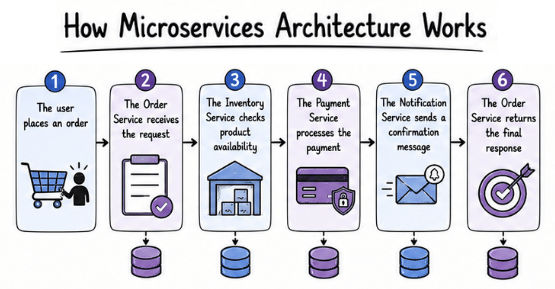
When a user places an order, multiple services work together to complete the request.
A typical flow looks like this:
The user places an order.
The Order Service receives the request.
The Inventory Service checks product availability.
The Payment Service processes the payment.
The Notification Service sends a confirmation message.
The Order Service returns the final response.
Although each service works independently, they communicate to complete a single business operation.
Consider an online shopping platform such as Amazon.
When you place an order, different services handle different tasks:
The User Service verifies your account.
The Product Service provides product information.
The Inventory Service checks stock availability.
The Payment Service processes the payment.
The Shipping Service prepares the order for delivery.
The Notification Service sends an email or SMS confirmation.
Since each service works independently, updating one service usually does not affect the others.
Easier to develop and maintain
Independent deployment of services
Scale individual services based on demand
Smaller and more manageable codebases
Better collaboration between development teams
A failure in one service does not necessarily affect the entire application
More complex to design and manage
Communication between services increases network overhead
Monitoring and debugging become more difficult
Managing multiple services and databases requires additional tools
Service discovery, security, and monitoring must be planned carefully
Microservices are a good choice when:
You are building a large application.
Multiple teams work on different features.
The application needs to support a large number of users.
Different services need to scale independently.
The application is expected to grow continuously.
For smaller applications or startup projects, Monolithic Architecture or Modular Monolith is often a simpler and more practical choice.
Many well-known technology companies use Microservices Architecture to build and operate large-scale applications, including:
Amazon
Netflix
Uber
Spotify
PayPal
Microservices allow these companies to develop, deploy, and scale individual services independently, making it easier to support millions of users and deliver new features more frequently.
Feature | Monolithic Architecture | Microservices Architecture |
|---|---|---|
Structure | Single, unified application | Divided into multiple independent services |
Deployment | Entire application is deployed together | Each service can be deployed independently |
Scalability | Entire application must be scaled | Individual services can be scaled independently |
Maintenance | Harder to maintain as the application grows | Easier to maintain because each service is managed separately |
Team Collaboration | Usually managed by a single team | Multiple teams can work on different services |
Best For | Small to medium-sized applications | Large-scale and enterprise applications |
Event-Driven Architecture (EDA) is a modern software architecture in which different services communicate by sending and receiving events.
An event is any action or change that occurs in an application, such as a user signing up, placing an order, making a payment, or uploading a file. Instead of communicating directly, one service publishes an event, and other services subscribe to and respond to it when needed.
In simple words, Event-Driven Architecture allows services to communicate by exchanging events instead of making direct requests.
This architecture is commonly used in e-commerce platforms, banking systems, payment applications, real-time notification systems, and IoT applications.
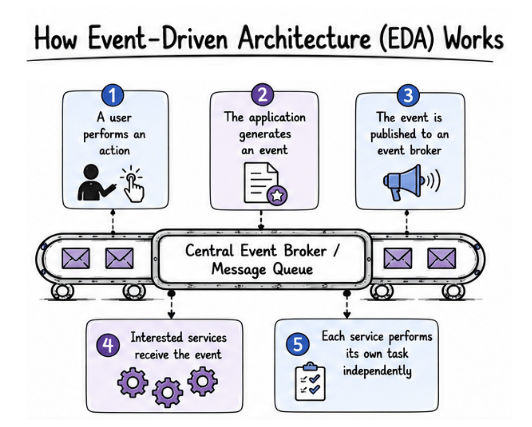
The communication flow typically follows these steps:
A user performs an action.
The application generates an event.
The event is published to an event broker (or message broker).
Interested services receive the event.
Each service performs its own task independently.
Since services communicate through events rather than direct calls, they remain loosely coupled and can evolve independently.
Suppose a customer places an order on an online shopping website.
The process works as follows:
The Order Service publishes an Order Placed event.
The Payment Service processes the payment.
The Inventory Service updates the product stock.
The Shipping Service prepares the order for delivery.
The Notification Service sends an email or SMS confirmation.
Each service performs its own responsibility independently after receiving the event.
Loose coupling between services
Better scalability
Supports real-time event processing
Improves application flexibility
One event can trigger multiple services
Improves fault isolation between services
More complex to design and implement
Debugging and tracing events can be difficult
Maintaining event order and consistency can be challenging
Requires an event broker such as Apache Kafka or RabbitMQ
Event-Driven Architecture is a good choice when:
Your application processes real-time events.
Multiple services need to respond to the same event.
You are building a distributed system.
Loose coupling and scalability are important.
Different services should work independently.
Serverless Architecture is a cloud-based architecture where developers only need to write application code. The cloud provider takes care of server management, scaling, maintenance, and resource allocation.
In simple words:
In Serverless Architecture, you focus on building your application while the cloud provider manages the servers automatically.
Some popular serverless platforms are:
AWS Lambda
Azure Functions
Google Cloud Functions
The process is simple:
A user sends a request.
The cloud platform receives the request.
It automatically starts the required function.
The function processes the request.
The result is sent back to the user.
After the task is complete, the function stops running.
With this approach, you pay only for the time your code runs.
Imagine a user uploads a profile picture to a social media application.
A serverless function starts automatically and:
Resizes the image.
Compresses the file.
Stores it in cloud storage.
Returns the image URL to the application.
Once the task is finished, the function stops automatically without keeping a server running.
Serverless Architecture offers several benefits:
No need to manage servers.
Automatically scales based on traffic.
Reduces infrastructure costs for many applications.
Speeds up application development.
You pay only for actual usage.
Works well with cloud services and APIs.
There are also some limitations:
Cold starts may slow down the first request.
Functions have a limited execution time.
Moving to another cloud provider can be difficult because of vendor-specific services.
Developers have less control over the server environment.
Serverless Architecture is a good choice when:
Building event-driven applications.
Creating APIs and backend services.
Processing uploaded files, images, or videos.
Running scheduled or background tasks.
Handling applications with changing or unpredictable traffic.
Many well-known companies use serverless technology for different workloads, including:
Netflix
Airbnb
Coca-Cola
BBC
Amazon
These companies use serverless services for tasks such as API development, file processing, notifications, automation, and background jobs.
Feature | Event-Driven Architecture | Serverless Architecture |
|---|---|---|
Main Focus | Services communicate through events | Run application code without managing servers |
Communication | Uses events and message brokers | Functions run when triggered by an event or request |
Scalability | Easy to scale across multiple services | Automatically scales based on demand |
Server Management | Managed by developers or cloud providers | Fully managed by the cloud provider |
Best For | Real-time and distributed applications | APIs, automation, file processing, and background tasks |
Clean Architecture is a software design approach that keeps the business logic separate from frameworks, databases, and other external tools. This makes an application easier to maintain, test, and update as it grows.
The main idea is that your core business logic should not depend on any specific technology. This means you can change the database, framework, or API without making major changes to your business rules.
In simple words:
Clean Architecture keeps the core business logic independent, so the application is easier to maintain and improve.
It is widely used in enterprise applications, banking systems, healthcare software, and large backend projects.
Clean Architecture is usually divided into four main layers.
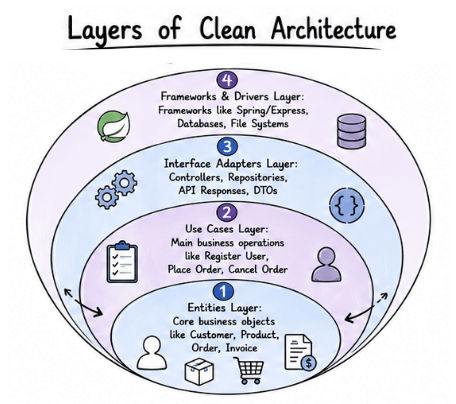
The Entities layer contains the core business objects and rules of the application.
Examples include:
Customer
Product
Order
Invoice
These objects should not depend on databases, APIs, or frameworks.
The Use Cases layer contains the main business operations of the application.
Examples:
Register User
Place Order
Process Payment
Cancel Order
This layer uses the business rules defined in the Entities layer.
The Interface Adapters layer connects the business logic with external systems.
It may include:
Controllers
Database Repositories
API Responses
DTOs (Data Transfer Objects)
Its job is to convert data into a format that both the application and external systems can understand.
This is the outer layer of the application. It contains technologies such as:
Spring Boot
ASP.NET Core
Express.js
Databases
File Systems
Third-party APIs
These technologies can be changed without affecting the core business logic.
The process works in these simple steps:
A user sends a request.
The controller receives the request.
The controller calls the required use case.
The use case applies the business rules.
If data is needed, the repository communicates with the database.
The application returns the response to the user.
This structure keeps the business logic separate from external technologies.
Suppose a customer places an order on an online shopping website.
The application handles the request like this:
The Controller receives the order request.
The Place Order Use Case validates the order.
The Order Entity applies the business rules.
The Repository stores the order in the database.
The application sends a success response to the customer.
If you later switch from MySQL to PostgreSQL, only the database layer changes. The business logic remains the same.
Clean Architecture offers several benefits:
Keeps business logic independent.
Makes testing easier.
Improves code maintenance.
Supports long-term projects.
Makes it easier to change frameworks or databases.
Like any architecture, it also has some challenges:
Requires more files and folders.
Takes more time to set up.
May feel unnecessary for small applications.
Clean Architecture is a good choice when:
Building medium or large applications.
The project is expected to grow over time.
Multiple developers are working on the project.
Long-term maintenance and scalability are important.
Hexagonal Architecture, also called Ports and Adapters Architecture, is a software architecture that keeps the application's business logic separate from external systems such as databases, APIs, user interfaces, and third-party services.
The main goal is to make the core application independent of any specific technology. This makes the application easier to maintain, test, and update.
In simple words:
Hexagonal Architecture keeps the business logic at the center, while external systems connect through ports and adapters.
It is commonly used in enterprise applications, backend systems, and projects that require flexibility and easy testing.
Hexagonal Architecture is built around three main components.
The Core Application contains the main business logic and business rules.
It includes:
Business rules
Domain models
Core application logic
This layer does not depend on databases, frameworks, or external services.
Ports are interfaces that define how the application communicates with the outside world.
For example, a port may define actions like:
Save an order
Find a customer
Send a notification
A port describes what the application should do, but not how it is done.
Adapters provide the actual implementation of the ports.
Some common examples are:
MySQL Adapter
PostgreSQL Adapter
REST API Adapter
Message Queue Adapter
Email Adapter
If a technology changes, you usually need to update only the adapter, while the business logic remains unchanged.
The process works in these simple steps:
A request reaches the application.
An adapter receives the request.
The adapter calls the appropriate port.
The business logic processes the request.
Another adapter communicates with the database or an external service.
The application returns the response to the user.
This approach keeps the business logic independent from external technologies.
Suppose your application stores customer data in MySQL.
Later, your company decides to switch to MongoDB.
With Hexagonal Architecture:
The business logic stays the same.
Only the database adapter needs to be replaced.
This makes technology changes faster and easier.
Hexagonal Architecture offers several benefits:
Keeps business logic separate from infrastructure.
Makes unit testing easier with mock adapters.
Simplifies replacing databases or external services.
Encourages clean and maintainable code.
Supports long-term application growth.
It also has some challenges:
More complex than traditional architectures.
Requires careful planning and design.
Creates more interfaces and classes.
May not be suitable for small applications.
Hexagonal Architecture is a good choice when:
Building enterprise applications.
Working with multiple external systems.
Long-term maintenance is important.
The application may use different technologies in the future.
Feature | Clean Architecture | Hexagonal Architecture |
|---|---|---|
Main Goal | Keep business logic independent from external technologies | Keep business logic separate using ports and adapters |
Design Approach | Organized into different layers | Uses ports and adapters for communication |
Database Dependency | Independent of the database | Independent of the database |
Framework Dependency | Does not depend on frameworks | Does not depend on frameworks |
Testability | High | High |
Best For | Medium to large applications | Enterprise applications with multiple external integrations |
Domain-Driven Design (DDD) is a software design approach that focuses on solving business problems by organizing the application around the business domain instead of technical details.
A domain is the business area for which the application is built.
For example:
Banking
E-commerce
Healthcare
Education
Food Delivery
Instead of starting with the database or framework, DDD begins by understanding the business rules, processes, and requirements.
In simple words:
Domain-Driven Design helps developers build software that reflects real business needs and processes.
DDD is widely used in enterprise applications, banking systems, healthcare platforms, and large Microservices-based applications.
To understand DDD, let's look at its main building blocks.
The Domain is the business area the application is designed to support.
Examples include:
Online Banking
Hospital Management
Online Shopping
Food Delivery
Everything in the application is designed around this business domain.
An Entity is an object with a unique identity.
Examples:
Customer
Product
Employee
Order
Even if some of its details change, its identity remains the same.
A Value Object is identified by its values instead of a unique identity.
Common examples are:
Address
Money
Phone Number
If the value changes, it is treated as a new object.
An Aggregate is a group of related entities and value objects that are managed as a single unit.
For example, an Order aggregate may contain:
Customer
Order Items
Shipping Address
Payment Details
These objects work together to represent one complete order.
A Repository provides a simple way to store and retrieve domain objects.
Instead of accessing the database directly, the business logic communicates with the repository, making the application cleaner and easier to maintain.
Imagine you are building an online banking application.
Instead of organizing the project around database tables, you organize it around business concepts such as:
Customer
Account
Transaction
Loan
Payment
This approach makes the application easier to understand because the code matches the real business process.
Domain-Driven Design offers several benefits:
Focuses on solving real business problems.
Improves communication between developers and business experts.
Organizes large applications more effectively.
Works well with Microservices Architecture.
Makes complex business logic easier to manage.
Like any approach, DDD also has some challenges:
Takes time to learn and implement.
Requires a clear understanding of the business domain.
May be unnecessary for small or simple applications.
Domain-Driven Design is a good choice when:
Building enterprise applications.
Solving complex business problems.
Developing large Microservices-based systems.
Business rules are expected to change over time.
Backend for Frontend (BFF) is an architecture pattern where each frontend application has its own dedicated backend. Instead of using a single backend for all clients, every frontend communicates with a backend that is designed specifically for its needs.
For example:
Web Application → Web BFF
Android App → Mobile BFF
iOS App → Mobile BFF
Smart TV App → TV BFF
Each BFF is optimized for the frontend it serves.
In simple words:
Backend for Frontend (BFF) gives each frontend its own backend, making the application faster, simpler, and easier to manage.
This pattern is commonly used in large web applications, mobile apps, e-commerce platforms, and Microservices-based systems.
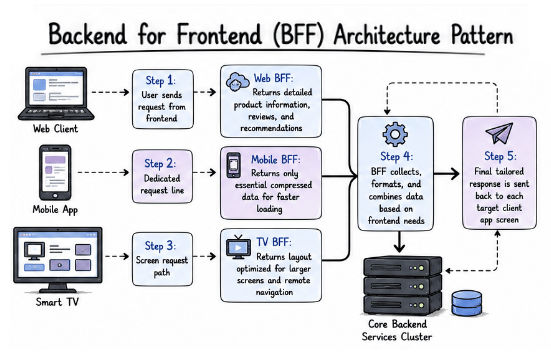
The process works in these simple steps:
A user sends a request from a frontend application.
The request goes to its dedicated BFF.
The BFF collects data from one or more backend services.
It formats and combines the data based on the frontend's needs.
The final response is sent back to the frontend.
This allows each frontend to receive only the required data, improving performance and reducing unnecessary network traffic.
Imagine an online shopping platform that has:
A Website
An Android App
An iOS App
Each platform needs data in a different format.
For example:
The Web BFF returns detailed product information with reviews and recommendations.
The Mobile BFF returns only the essential data for faster loading.
The TV BFF returns data optimized for larger screens and remote navigation.
Although each frontend uses a different BFF, they all communicate with the same backend services.
Backend for Frontend provides several benefits:
Improves performance for each frontend.
Simplifies frontend development.
Makes API responses easier to customize.
Reduces unnecessary data transfer.
Allows frontend and backend teams to work independently.
There are also some challenges:
More backend services need to be maintained.
Infrastructure costs may increase.
Similar logic can be duplicated across multiple BFFs if not designed carefully.
Backend for Frontend is a good choice when:
You have multiple frontend applications.
Each frontend requires different data.
Different teams manage different frontend applications.
Optimizing performance and user experience is a priority.
Modern software architectures help developers build applications that are scalable, maintainable, and flexible. Each architecture is designed to solve different challenges, so the right choice depends on your application's requirements.
In this article, you learned the purpose of:
Microservices Architecture
Event-Driven Architecture (EDA)
Serverless Architecture
Clean Architecture
Hexagonal Architecture
Domain-Driven Design (DDD)
Backend for Frontend (BFF)
There is no single architecture that works best for every project. Consider factors such as application size, business requirements, scalability, team structure, and future growth before choosing an architecture.
Understanding these architectures will help you design better software and prepare you for advanced topics like System Design, Cloud Computing, and Distributed Systems.
