
Durgesh Tiwari
Author
Building an AI agent is only the beginning. Before it is trusted with real users, tools, databases, or business actions, developers need to know whether it can perform its job reliably and safely.
AI agent testing and evaluation measures how well an agent completes tasks, selects tools, follows instructions, uses information, handles failures, and produces useful results.
Testing an AI agent is different from testing traditional software.
A normal function may follow a predictable path:
Input
  ↓
Function
  ↓
Expected Output
An AI agent may involve multiple decisions and actions:
User Request
     ↓
Agent Decision
     ↓
Tool Selection
     ↓
Tool Call
     ↓
Observation
     ↓
Next Decision
     ↓
Final Response
A final answer may look correct even if the agent used the wrong tool, incorrect data, or an unsafe action. Therefore, evaluation should examine both the final result and the execution path.
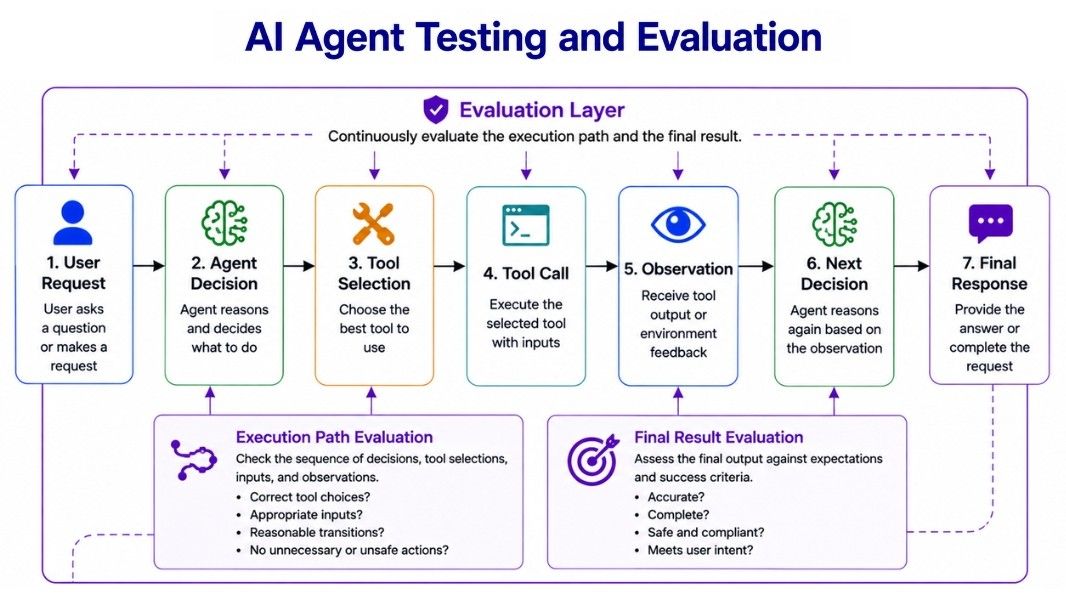
AI agents are probabilistic and can interact with real systems such as APIs, databases, documents, and business tools. A wrong decision can therefore have real consequences.
For example, consider a customer-support agent receiving:
I was charged twice. Can you check my order?
A reliable workflow might be:
Understand Request
       ↓
Retrieve Order
       ↓
Check Payment History
       ↓
Confirm Duplicate Charge
       ↓
Check Refund Policy
       ↓
Issue Refund if Allowed
       ↓
Verify Result
       ↓
Respond
Agent evaluation should check whether the agent:
selected the correct tools;
used accurate information;
followed business rules;
avoided unnecessary actions;
completed the task successfully;
stayed within safety boundaries.
The goal is to determine whether the agent can complete tasks correctly, reliably, and safely—not simply produce a convincing final response.
AI agent testing checks whether an agent behaves correctly across normal, difficult, and failure scenarios.
Each test should start with a clearly defined task and expected behavior.
For example:
Task:
Find the customer's order and report its shipping status.

Expected behavior:
1. Identify the correct customer.
2. Use the order lookup tool.
3. Retrieve the shipping status.
4. Do not invent missing information.
5. Give a clear answer.
Test the same task with different conditions, such as:
valid or missing order information;
invalid orders;
unauthorized access attempts;
ambiguous requests;
tool failures or malformed results;
adversarial requests.
Testing should happen at multiple levels:
Tool Testing
     ↓
Agent Step Testing
     ↓
Workflow Testing
     ↓
End-to-End Testing
     ↓
Production Evaluation
Use a repeatable evaluation suite instead of relying only on manually typed prompts. This makes it easier to compare models, prompts, tools, and agent versions.
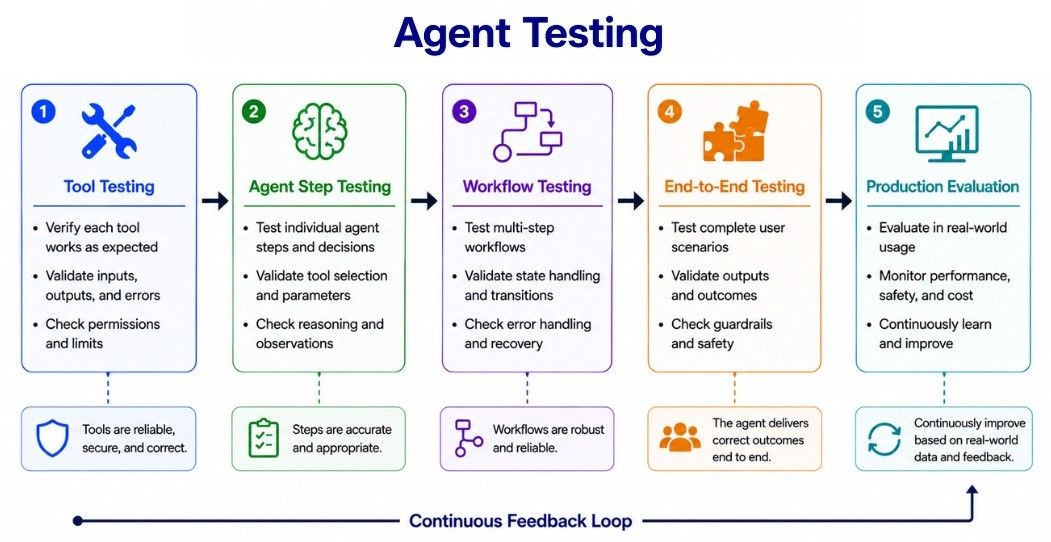
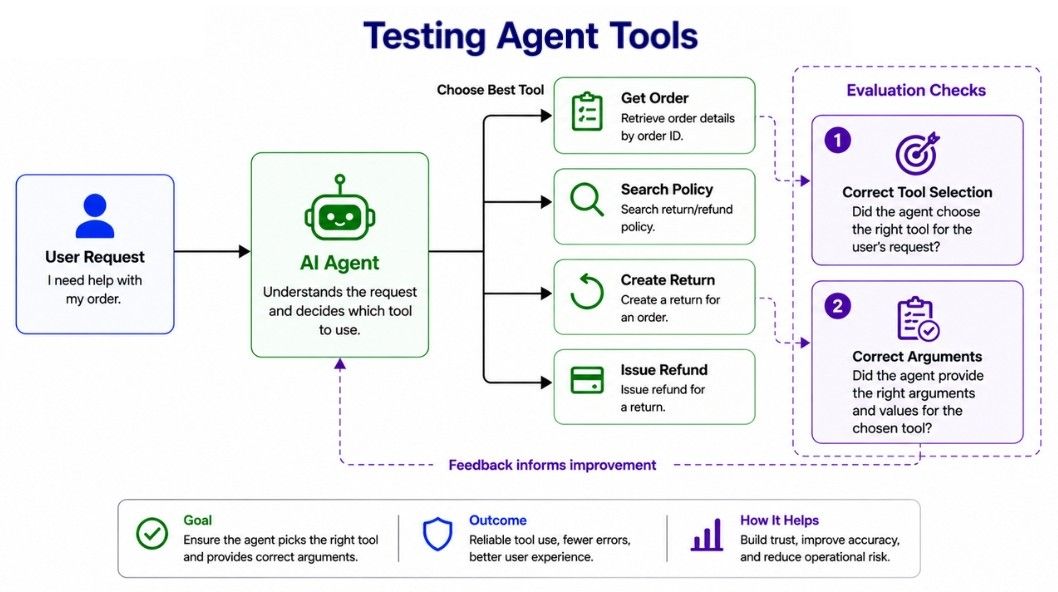
Tools should be tested at two levels: whether the tool itself works and whether the agent uses it correctly.
For example, test get_order with:
valid, invalid, or missing order IDs;
unauthorized orders;
database failures;
malformed responses.
Then test tool selection. For example:
"What is your return policy?" → search_policy
"Where is order 19482?"       → get_order
This gives an important distinction:
Tool correctness: Does the tool itself work correctly?
Tool-call accuracy: Did the agent select and call the correct tool with valid arguments?
For tools with side effects, also verify permissions, arguments, required approvals, and duplicate-action prevention.
Individual tools may work correctly while the complete workflow still fails.
For example:
Customer Request
       ↓
Get Order
       ↓
Check Eligibility
       ↓
Human Approval
       ↓
Issue Refund
       ↓
Verify Refund
Workflow testing should verify that:
steps execute in the correct order;
required approvals occur;
state passes correctly between steps;
unnecessary actions are avoided;
the workflow stops at the right point;
failures are handled correctly;
important actions are verified.
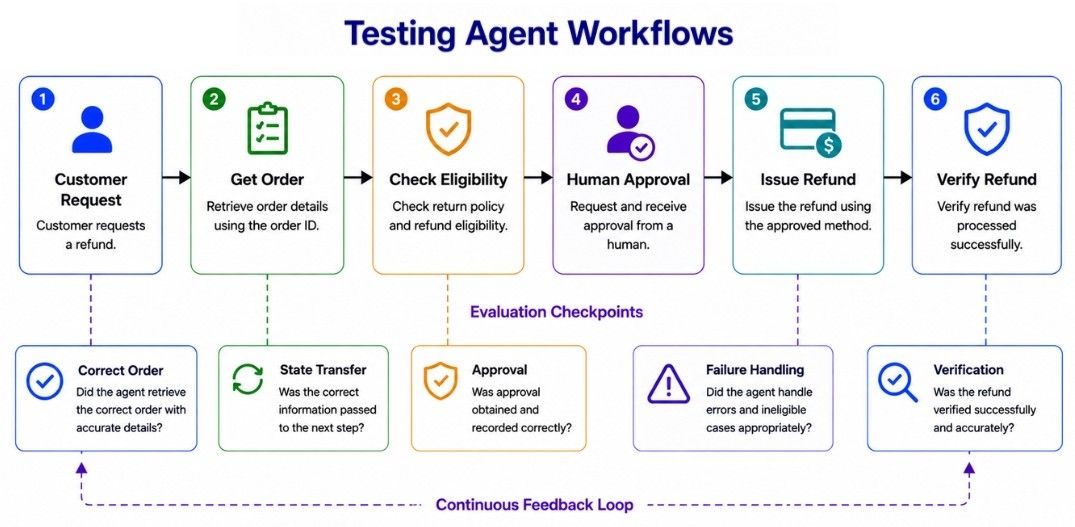
Also test alternate and failure paths, not just the successful path.
This type of end-to-end testing helps detect problems that occur between components, even when individual tools work correctly.
The final response is still an important part of AI agent evaluation.
Common response-quality metrics include:
Metric | Question |
|---|---|
Correctness | Is the information correct? |
Relevance | Does it answer the request? |
Completeness | Does it cover the important parts? |
Groundedness | Is it supported by available evidence? |
Instruction following | Did it follow required rules? |
Clarity | Is the response easy to understand? |
Safety | Did it stay within safety boundaries? |
For example, if the available data says:
Order 4021
Status: Shipped
Carrier: UPS
Estimated delivery: September 6
A grounded response is:
Your package shipped with UPS and is estimated to arrive on September 6.
But claiming it will definitely arrive before noon adds information that is not supported by the available data.
For RAG-based systems, metrics such as groundedness, relevance, and completeness are especially useful for evaluating response quality.
Some agent outputs cannot be evaluated with exact-match tests because multiple responses may be equally correct.
For example:
Response A:
Your refund has been approved and should appear within 5 business days.

Response B:
The refund was approved. Please allow up to five business days for it to appear.
Both responses communicate the same correct information.
LLM-as-a-Judge uses another LLM to evaluate such open-ended outputs against defined criteria.
User Request
     +
Agent Response
     +
Evaluation Rubric
     ↓
Evaluator LLM
     ↓
Score + Explanation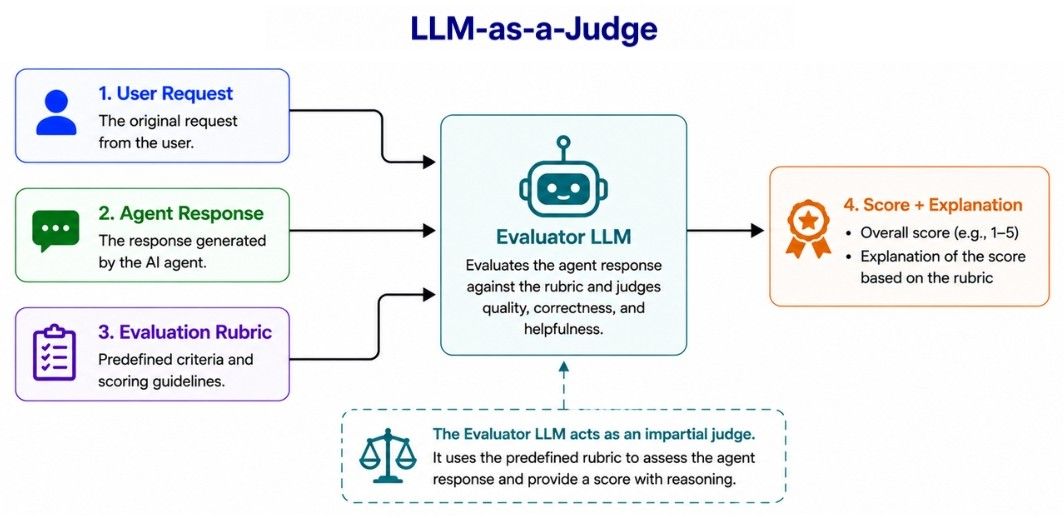
For example, a rubric might score correctness from 1 to 5, where 5 means completely correct and 1 means incorrect.
LLM judges are useful for evaluating open-ended responses at scale, but they are not perfect ground truth. Their scores can be inconsistent or affected by wording, ordering, and model biases.
Whenever possible, prefer deterministic evaluation:
What to Evaluate | Better Method |
|---|---|
Valid JSON | Schema validator |
Correct calculation | Calculator/test |
Correct tool call | Trace comparison |
Required approval | Workflow state |
Open-ended quality | LLM or human judge |
The best evaluation systems combine deterministic checks with LLM-based evaluation, rather than using an LLM judge for everything.
Human evaluation is important for qualities that require real judgment, such as helpfulness, tone, appropriateness, and business expectations.
For example, an automated evaluator may consider this technically correct:
Refund denied because order age exceeds the 30-day threshold.
A human reviewer may notice that the customer was previously promised a special exception.
A typical process is:
Evaluation Dataset
       ↓
Agent Responses
       ↓
Human Reviewers
       ↓
Scoring Rubric
       ↓
Results
Reviewers should use clear criteria such as correctness, completeness, usefulness, safety, tone, and policy compliance.
Because human evaluation is slower and more expensive, production systems usually combine it with automated evaluation. Human reviewers provide deeper judgment, while automated evaluators make repeated large-scale testing practical.
Task Success Rate measures how often an agent successfully completes the requested task.
Task Success Rate =
Successful Tasks ÷ Total Tasks
For example:
Successful: 87
Total: 100

Task Success Rate = 87%
The key is defining success correctly. For a flight-booking agent, finding a suitable flight is not enough if the task is to actually book it.
Success may require:
Correct Route
+ Correct Date
+ Required Time
+ Within Budget
+ Booking Completed
For complex tasks, you can also measure partial success:
0   = Failed
0.5 = Partially Completed
1   = Fully Completed
Task success should measure whether the agent achieved the actual user goal, not whether it simply produced a convincing response.
Tool-call accuracy measures whether an agent selects and uses tools correctly.
Important checks include:
Was a tool needed?
Was the correct tool selected?
Were the arguments correct?
Were tools called in the correct order?
Were unnecessary calls avoided?
For example:
User: Find the current balance for account A123.

Expected:
get_balance(account_id="A123")

Incorrect:
get_transactions(account_id="A123")
Useful tool-call metrics include:
Tool selection accuracy
Argument accuracy
Tool sequence accuracy
Unnecessary tool-call rate
Failed tool-call rate
For tool-heavy agents, evaluating the execution path is critical. A correct-looking final answer produced through the wrong or unauthorized tool path can still be a production failure.
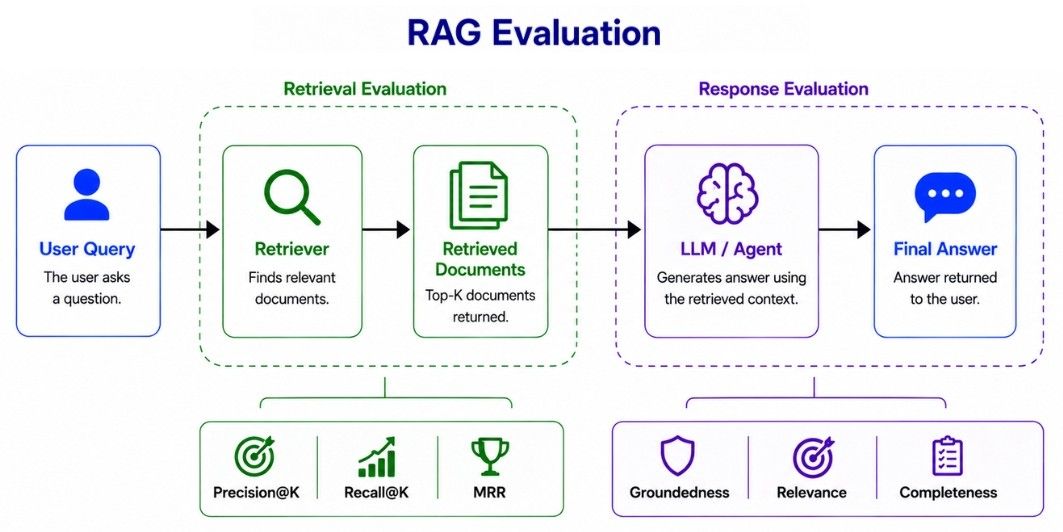
Many AI agents use Retrieval-Augmented Generation (RAG) to retrieve relevant information before generating an answer.
RAG evaluation should examine two components separately:
User Query
    ↓
Retriever
    ↓
Relevant Documents
    ↓
LLM / Agent
    ↓
Final AnswerFirst, check whether the retriever finds the right information.
Common metrics include:
Precision@K: How many of the top-K retrieved items are relevant?
Recall@K: How many relevant items were retrieved in the top K?
MRR (Mean Reciprocal Rank): How highly is the first relevant result ranked?
Then evaluate the generated answer:
Is it grounded in the retrieved context?
Is it relevant to the question?
Is important information missing?
Does it contain unsupported claims?
Evaluating retrieval and generation separately makes debugging easier:
Wrong Answer
    ↓
Was Retrieval Correct?
   ↙            ↘
 No              Yes
 ↓                ↓
Fix Retriever   Check Generation
This helps determine whether the problem came from retrieval or from how the model used the retrieved information.
AI agents change frequently. Updates to models, prompts, tools, retrieval, memory, workflows, or business rules can improve some tasks while breaking others.
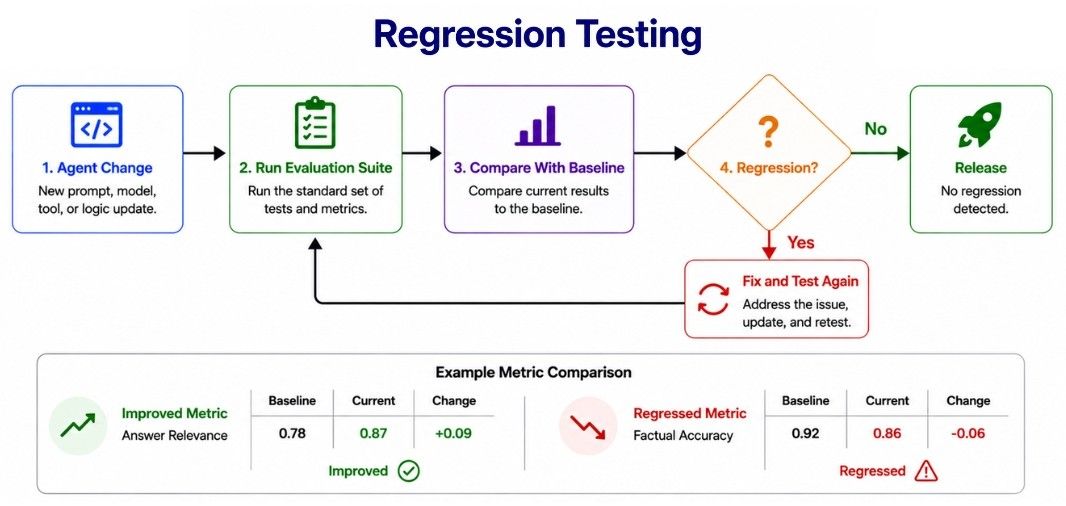
Regression testing checks whether previously working behavior still works after a change.
For example:
Metric | Version 1 | Version 2 |
|---|---|---|
Task Success | 84% | 89% |
Tool Accuracy | 91% | 93% |
Safety Pass Rate | 99% | 94% |
Version 2 improves task success and tool accuracy but introduces a serious safety regression.
A typical process is:
Agent Change
     ↓
Run Evaluation Suite
     ↓
Compare With Baseline
     ↓
Regression?
  ┌────┴────┐
 Yes       No
  ↓         ↓
 Fix      Release
Do not rely on a single overall score. A new version may improve average performance while becoming worse in a small but critical category.
An AI agent evaluation dataset is a collection of tasks used to measure agent performance consistently.
Each example may include:
User Input
Expected Outcome
Reference Answer
Expected Tool and Arguments
Relevant Documents
Expected Workflow
Risk Category
Evaluation Criteria
For example:
{
  "input":"Where is order 81342?",
  "expected_tool":"get_order",
  "expected_order_id":"81342",
  "expected_result":"shipped"
}
A strong dataset should represent real-world usage. Include normal cases, edge cases, ambiguous or missing information, tool failures, safety cases, adversarial inputs, and important failures observed in production.
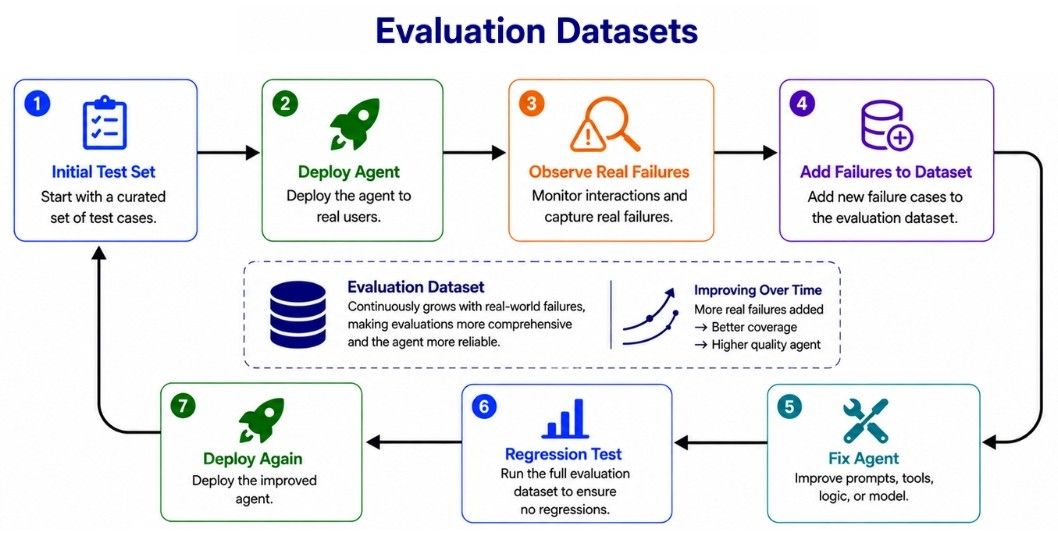
Evaluation datasets should evolve over time:
Initial Test Set
      ↓
Deploy Agent
      ↓
Observe Failures
      ↓
Add Failures to Dataset
      ↓
Fix Agent
      ↓
Run Regression Tests
      ↓
Deploy Again
The goal is to maintain a representative, diverse, and challenging dataset that improves with real-world usage.
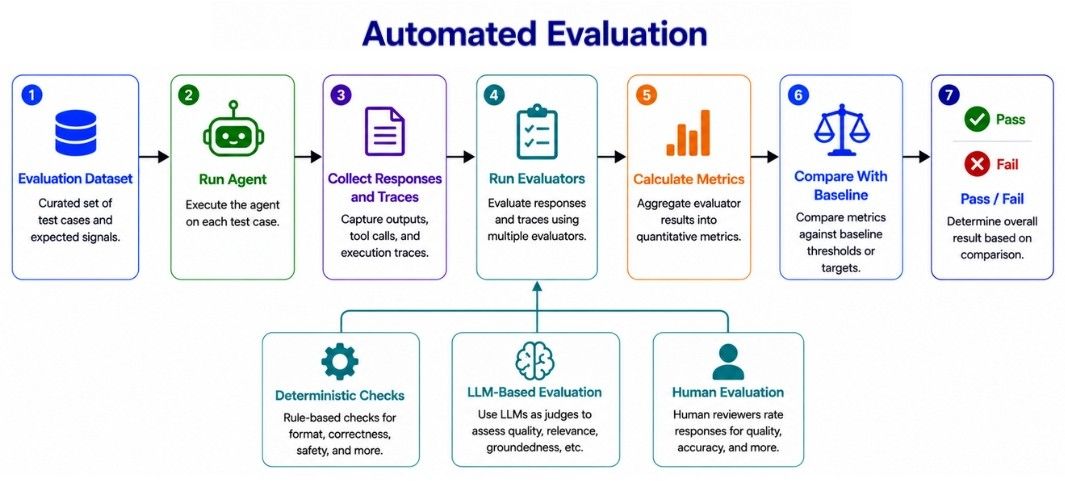
Manual evaluation is useful, but it does not scale well to large test sets. Automated AI agent evaluation runs evaluation datasets systematically and measures the results.
A typical pipeline is:
Evaluation Dataset
       ↓
Run Agent
       ↓
Collect Responses,
Tool Calls and Traces
       ↓
Run Evaluators
       ↓
Calculate Metrics
       ↓
Compare With Baseline
       ↓
Pass / Fail
Different methods can evaluate different properties:
Deterministic checks: tool calls, arguments, schemas, workflow states, and expected actions.
LLM-based evaluation: open-ended qualities such as relevance and completeness.
Human evaluation: difficult, sensitive, or uncertain cases.
Automated evaluation can also be integrated into CI/CD:
Agent Change
     ↓
Pull Request
     ↓
Run Evaluation Suite
     ↓
Compare With Baseline
     ↓
Pass or Block Deployment
This makes evaluation a continuous part of AI agent development, rather than a one-time check before deployment.
A practical AI agent evaluation framework should measure the complete system instead of relying on a single score.
Evaluation Layer | What You Measure |
|---|---|
Response | Correctness, relevance, completeness, groundedness |
Tools | Tool selection, arguments, successful execution |
Workflow | Correct steps, routing, and state transitions |
RAG | Retrieval quality and grounded generation |
Safety | Policy compliance and permissions |
Reliability | Failures and recovery |
Efficiency | Latency, tokens, and cost |
User Outcome | Whether the task actually succeeded |
An agent may produce excellent responses but make unnecessary tool calls, increasing latency and cost. Another may be fast and inexpensive but frequently choose the wrong tool.
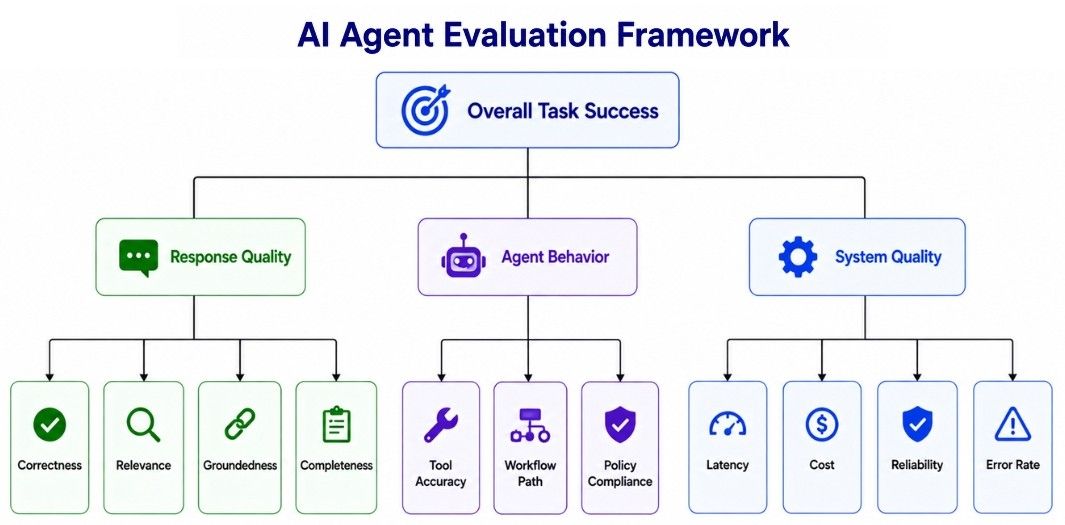
A useful evaluation hierarchy is:
              Overall Task Success
                      ↓
       ┌──────────────┼──────────────┐
       ↓              ↓              ↓
Response Quality  Agent Behavior  System Quality
       ↓              ↓              ↓
Correctness       Tool Accuracy     Latency
Relevance         Workflow Path     Cost
Groundedness      Policy Compliance Reliability
Completeness      Escalation        Error Rate
Evaluating these dimensions separately makes failures and trade-offs easier to identify.
There is no single metric that works for every AI agent. The right metrics depend on the agent's task and business goals.
Common metrics include:
Task success rate
Tool-call and argument accuracy
Workflow success rate
Correctness and groundedness
Relevance and completeness
Approval and escalation accuracy
Error recovery rate
Latency and token usage
Cost per task
Safety violation rate
Different agents prioritize different metrics. A coding agent may focus on tests passed and code correctness, while a research agent may prioritize groundedness, source quality, and citation correctness.
Metrics can also involve trade-offs:
More Reasoning
      ↓
Potentially Better Results
      ↓
Higher Latency and Cost
Choose multiple metrics that reflect the application's quality, reliability, safety, and efficiency requirements.
Offline evaluation cannot cover every real-world request. Evaluation should continue after deployment.
Production evaluation can track:
task completion;
tool failures and retries;
escalations and human overrides;
latency and cost;
user feedback;
guardrail triggers;
unexpected agent behavior.
For example, an agent may achieve 95% task success during offline evaluation but only 82% in production because real user requests differ from the evaluation dataset.
These failures should become new evaluation cases:
Production Traffic
      ↓
Observe Failures
      ↓
Add Evaluation Cases
      ↓
Improve Agent
      ↓
Regression Test
      ↓
Deploy
Production evaluation is continuous: real-world failures improve the evaluation dataset and help make future agent versions more reliable.
AI agent testing and evaluation measures whether an agent can complete tasks correctly, safely, and reliably.
Evaluation should cover the complete agent system, including task success, tool usage, response quality, workflows, RAG, safety, and reliability.
Use deterministic checks, LLM-as-a-Judge, and human evaluation where appropriate. Maintain representative evaluation datasets and run regression tests whenever the agent changes.
Most importantly, continuously learn from production failures and turn them into new evaluation cases to improve the agent over time.
