
Durgesh Tiwari
Author
The future of agentic AI is moving beyond simple chatbots toward AI systems that can use tools, work across applications, complete longer workflows, and collaborate with people.
The important shift is not simply toward more autonomy. As agents receive greater capabilities and access to real systems, reliability, security, permissions, interoperability, accountability, and human control become increasingly important.
The likely future is therefore not “AI agents doing everything automatically,” but more capable agents operating with appropriate levels of autonomy and strong engineering controls.
Several trends are shaping the future of agentic AI.
Agents are moving from simple question-answering toward systems that can perform multiple connected steps.
Chatbots
   ↓
Tool-Using Agents
   ↓
Workflow Agents
   ↓
Longer Agentic Workflows
For example, instead of only generating a report, an agent may:
collect information;
analyze multiple sources;
use business tools;
prepare the report;
request approval if necessary;
perform an authorized follow-up action.
Agent use is expanding beyond coding assistants into areas such as:
research;
customer support;
data analysis;
internal knowledge;
reporting;
business process automation;
software development.
The important question for organizations is becoming less about:
Can we build an AI agent?
and more about:
Where does an AI agent create enough value to justify its complexity and risk?
Another important direction is interoperability.
Instead of every agent being an isolated application, agent systems are moving toward environments where they can connect with approved tools, services, data sources, and potentially other agents through standardized interfaces.
AI Agent
   ↓
Standardized Interfaces
   ↓
Tools / Data / Services / Other Agents
This can make integrations more reusable and reduce the need to build every connection from scratch.
However, interoperability also creates additional requirements around identity, authorization, trust, and security.
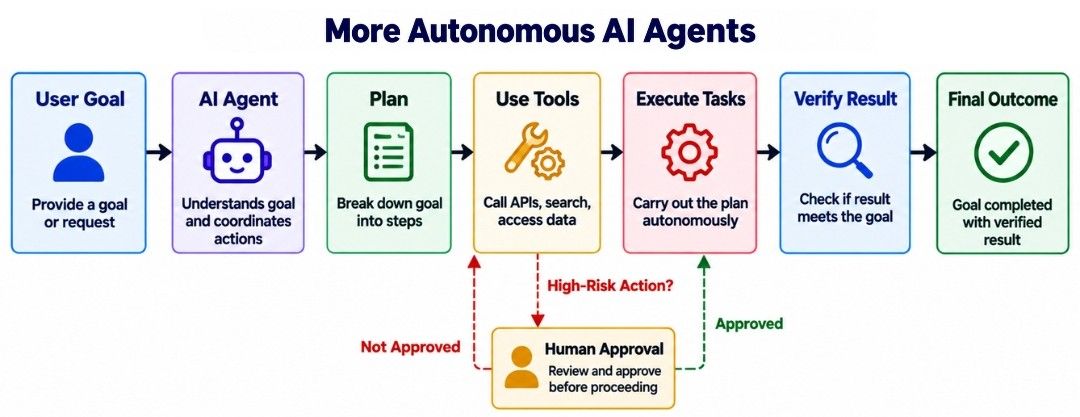
An autonomous AI agent can perform multiple steps toward a goal without requiring the user to manually direct every individual action.
Consider a coding task.
A basic AI assistant might suggest code.
A more autonomous coding agent could:
Understand Task
     ↓
Inspect Repository
     ↓
Plan Changes
     ↓
Edit Files
     ↓
Run Tests
     ↓
Analyze Result
     ↓
Fix if Needed
     ↓
Verify Result
As models, tools, and agent infrastructure improve, agents may be able to complete longer tasks before requiring human intervention.
But:
More autonomy does not automatically mean a better agent.
The appropriate autonomy level depends on the task and its potential impact.
Task | Possible Autonomy |
|---|---|
Draft an internal summary | High |
Research public information | High |
Prepare a customer response | Moderate |
Update important business records | Controlled |
Modify production infrastructure | Strongly restricted |
Transfer money | Strong authorization and approval |
A useful principle is:
Lower Risk
    ↓
More Automation

Higher Risk
    ↓
Stronger Controls
    ↓
Human Approval When Appropriate
The future is therefore likely to involve controlled autonomy: enough freedom for agents to be useful without giving them unnecessary authority.
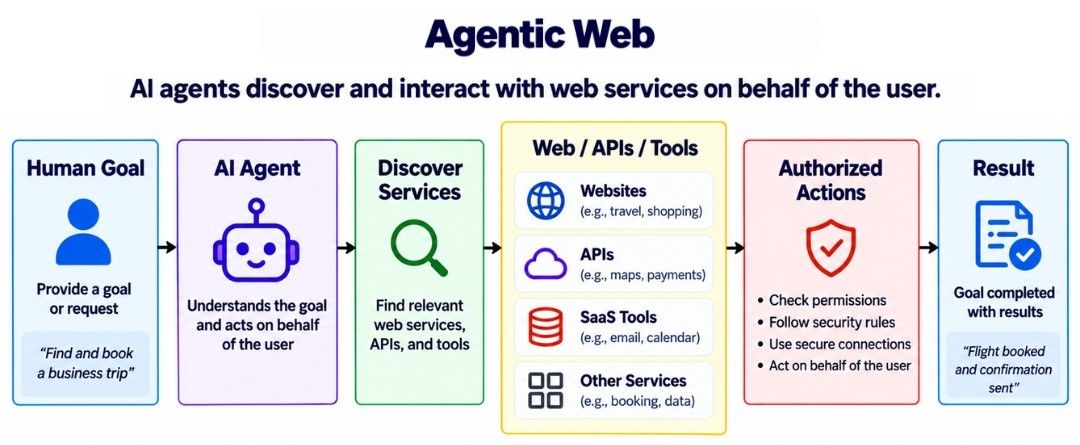
The agentic web describes an emerging direction in which AI agents interact with websites, applications, APIs, tools, and digital services on behalf of users.
Much of today's web is primarily designed for human interaction:
Human
  ↓
Browser
  ↓
Website
  ↓
Click / Search / Form
A more agent-oriented environment could look like:
Human Goal
    ↓
AI Agent
    ↓
Discover Available Capabilities
    ↓
Web / APIs / Tools / Services
    ↓
Perform Authorized Tasks
    ↓
Return Result
For example, organizing a business trip today may require a person to work across calendars, travel services, company policies, expense systems, and communication tools.
A future agent could potentially coordinate approved services across these systems from a single user goal.
User Goal
   ↓
Travel Agent
   ↓
┌────────┬────────┬──────────────┐
↓        ↓        ↓              ↓
Calendar Travel   Expense     Communication
         Service  Policy         Tools
└────────┴────────┴──────────────┘
             ↓
       Proposed Plan
             ↓
      Authorized Actions
Making this reliable requires more than better models.
Agents need reliable ways to:
discover available capabilities;
establish identity;
authenticate;
receive appropriate authorization;
exchange structured information;
operate securely.
The agentic web is therefore as much an infrastructure and interoperability challenge as it is an AI-model challenge.
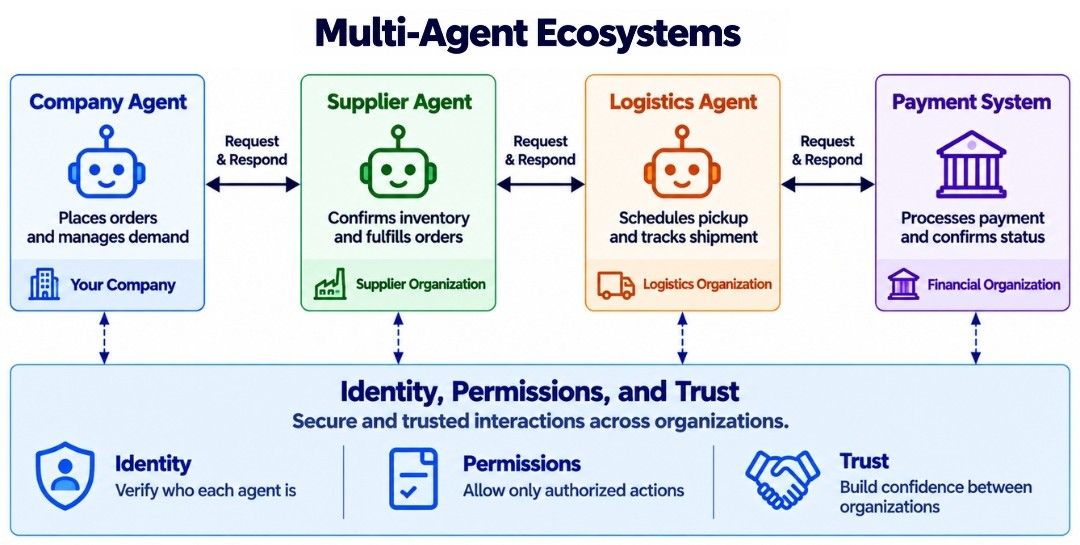
An important future direction is the development of agent ecosystems that can coordinate across applications, teams, and organizations.
The interesting future possibility is not simply putting several agents inside one application. That architecture has already been discussed earlier.
The larger possibility is interaction between independently operated agents and systems.
For example:
Company Agent
      ↕
Supplier Agent
      ↕
Logistics Agent
      ↕
Payment System
Such systems could coordinate business processes that currently require several applications and people.
For example, a company's procurement agent might communicate with an approved supplier system, check logistics information, and coordinate the next step in a purchasing workflow.
However, cross-agent interaction introduces important questions:
How does one agent verify another agent's identity?
What information can be shared?
Which actions can be delegated?
How are permissions preserved across systems?
How should trust be established?
Who is responsible when an interaction fails?
Another concern is the confused-deputy problem, where an agent with legitimate authority is manipulated into using that authority on behalf of another party that should not have it.
The future opportunity is therefore not simply connecting more agents.
It is building trusted and controlled mechanisms through which independent agents can interact safely.
Multi-agent ecosystems have significant potential, but they should not automatically be considered better than simpler architectures.
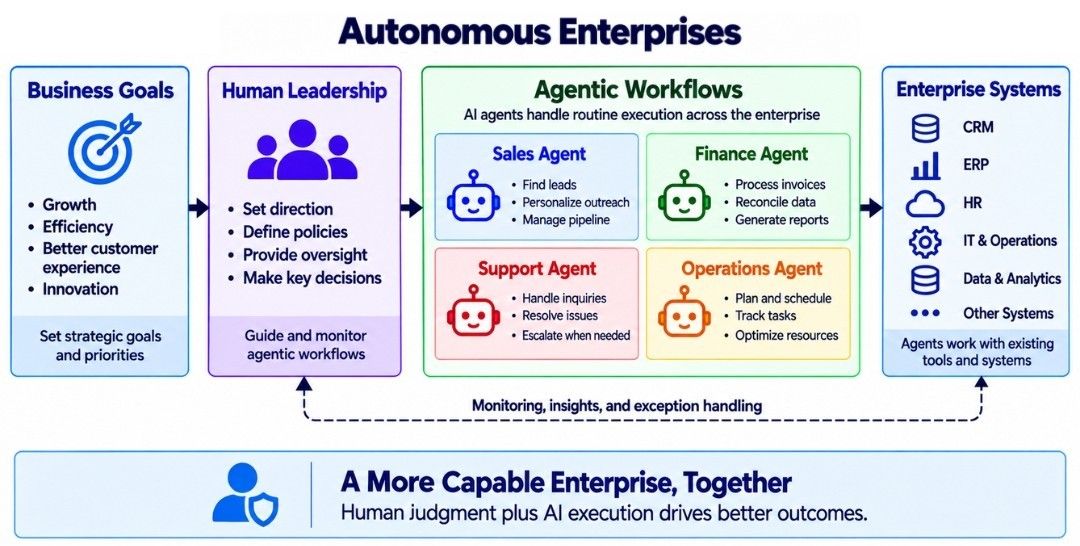
An autonomous enterprise is an idea in which AI agents participate in a significant portion of business operations.
Imagine specialized agentic systems across areas such as:
sales;
finance;
customer support;
procurement;
software development;
research;
operations;
human resources;
supply chain.
These systems could operate within a larger enterprise structure:
Business Goals
      ↓
Human Leadership
      ↓
Agentic Workflows
      ↓
┌────────┬────────┬─────────┐
↓        ↓        ↓         ↓
Sales  Finance  Support  Operations
Agents  Agents   Agents     Agents
└────────┴────────┴─────────┘
      ↓
Enterprise Systems
This does not necessarily mean a company without employees.
A more realistic direction is an organization where agents perform increasing amounts of routine execution, while people:
define goals;
resolve ambiguity;
make high-impact decisions;
provide judgment;
manage exceptions;
remain accountable for outcomes.
Full enterprise autonomy remains difficult because real organizations contain changing goals, incomplete information, exceptions, legal requirements, security boundaries, interpersonal decisions, and high-consequence actions.
The more practical future is therefore likely to be an increasingly agent-assisted enterprise, rather than a completely autonomous organization.
Terms such as AI employees, digital workers, and AI workers are increasingly used to describe agentic systems that perform ongoing work.
These terms should be interpreted carefully.
An AI agent is still software, not a human employee. It does not automatically possess human judgment, accountability, legal status, or organizational understanding.
A more practical way to think about a digital worker is:
A persistent agentic system assigned to a defined set of business responsibilities.
For example:
Digital Support Worker
        ↓
Monitor Support Queue
        ↓
Classify Requests
        ↓
Retrieve Information
        ↓
Resolve Approved Cases
        ↓
Escalate Exceptions
        ↓
Record Outcome
Such a system could continuously work on a bounded set of tasks while operating under defined permissions and organizational controls.
Instead of asking:
Can AI become an employee?
a more useful engineering question is:
Which parts of a role can an agent perform reliably, safely, and economically?
This keeps the discussion focused on practical capabilities rather than terminology.
Even as agents become more capable, human involvement is unlikely to disappear from important workflows.
Agents may increasingly handle routine execution, research, analysis, drafting, and workflow monitoring, while people focus more on goals, judgment, exceptions, quality standards, and accountability.
A simple future workflow might look like:
Human Defines Goal
        ↓
Agent Performs Work
        ↓
Agent Prepares Result
        ↓
Human Reviews When Needed
        ↓
Approved Work Executes
        ↓
Outcome Verified
The important future shift is not necessarily from humans to AI.
It may instead be a change in how work is divided between humans and AI systems.
As agent capabilities increase, an important human skill will be knowing:
What should be delegated, what should be verified, and what should remain under human control?
This makes human judgment more important in different parts of the workflow rather than eliminating it completely.
Full autonomy sounds attractive because it suggests that an agent could receive a goal and independently complete everything required.
Real environments make this much harder.
An agent can:
misunderstand the user's intent;
select the wrong tool;
retrieve incorrect information;
encounter unexpected system states;
receive malicious instructions from external content;
perform an individually valid action with an undesirable overall consequence.
Long workflows introduce another challenge.
Suppose a workflow contains 20 required steps and, purely for illustration, each step succeeds independently with probability 0.99.
Workflow Success ≈ 0.99^20
                 ≈ 81.8%
Real agent steps are not necessarily independent, so this is not a prediction of actual agent reliability.
It simply demonstrates an important principle:
Small per-step failure probabilities can compound across long workflows.
Real environments introduce additional uncertainty through changing data, APIs, permissions, network failures, human actions, and interactions with other agents.
Security also becomes increasingly important as autonomy grows because more autonomous agents may receive access to more valuable data and powerful tools.
The engineering challenge is therefore not:
How do we remove the human?
It is:
How much autonomy does this task actually need?
What can go wrong?
What permissions are necessary?
How can failures be detected?
When should the agent stop?
When should a human intervene?
These questions will remain important even as AI models become more capable.
The growth of agentic AI creates opportunities across areas such as research, software development, customer support, enterprise knowledge, data analysis, operations, finance, and business-process automation.
The larger opportunity is not simply creating more autonomous agents.
It is building better systems around AI models:
Models
  +
Tools
  +
Data
  +
Agent Workflows
  +
Interoperability
  +
Security
  +
Evaluation
  +
Human Oversight
As agent capabilities improve, organizations will need people who can turn those capabilities into reliable, secure, and useful systems.
The valuable engineering skill is therefore not simply knowing how to call an LLM API.
It is knowing how to design the complete system around AI models so that agents can accomplish useful tasks reliably and safely.
The detailed skills, roles, and career roadmap for working in this area will be covered separately in Article 29.
The future of agentic AI is moving toward more capable agents that can perform longer workflows, use tools, interact with external systems, and collaborate with humans and other agents.
Emerging directions such as the agentic web, interoperable agent ecosystems, digital workers, and agent-assisted enterprises could expand how agents are used in real-world systems.
However, greater autonomy also increases the importance of reliability, security, authorization, accountability, and human control.
The goal is not maximum autonomy, but useful and controlled autonomy that creates real value.
