
Author
Spring Boot applications follow a layered and modular architecture, which ensures that every part of your application has a clear responsibility. The Request → Response lifecycle shows how a client request flows through these layers until a response is returned.
Understanding this helps you debug issues faster, write better code, and design scalable applications.
This lifecycle can be divided into 8 main/core steps, which cover the essential flow from when a client sends a request to when the response is sent back:
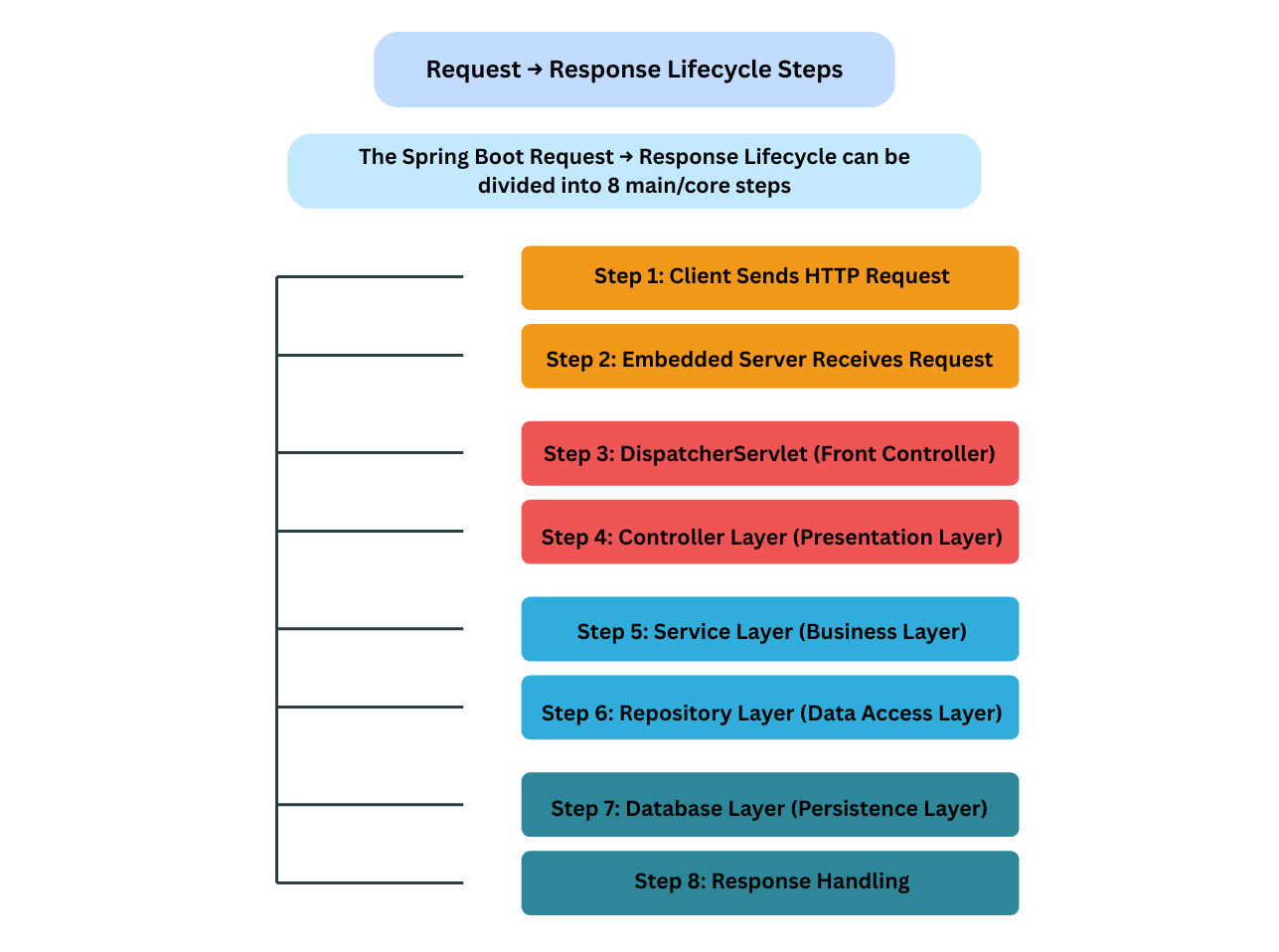
Everything starts when a client (browser, mobile app, or API consumer) sends an HTTP request to the Spring Boot application.
Example Request:
GET /users/123 HTTP/1.1
Host: localhost:8080
Spring Boot comes with embedded servers like Tomcat (default), Jetty, or Undertow.
Responsibilities of the Embedded Server:
➡ Why Embedded Servers Matter:
You don’t need to install or configure an external server manually. Your app is self-contained and production-ready.
The DispatcherServlet is the heart of Spring MVC. It manages how requests are routed in the application.
Key Tasks:
Internal Flow:
DispatcherServlet → HandlerMapping → Controller → View/Response
Controllers are annotated with @RestController or @Controller.
Responsibilities:
@RequestParam, @PathVariable).@RequestBody).@Valid, @Validated).@ExceptionHandler, @ControllerAdvice).Example:
@RestController
@RequestMapping("/users")
public class UserController {

    private final UserService userService;

    public UserController(UserService userService) {
        this.userService = userService;
    }

    @GetMapping("/{id}")
    public ResponseEntity<User> getUser(@PathVariable Long id) {
        User user = userService.getUserById(id);
        return ResponseEntity.ok(user);
    }
}
➡ Key Point: Controllers are only responsible for handling requests and sending responses, not business logic.
The Service Layer (@Service) contains all business logic.
Responsibilities:
@Transactional).Example:
@Service
public class UserService {

    private final UserRepository userRepository;

    public UserService(UserRepository userRepository) {
        this.userRepository = userRepository;
    }

    public User getUserById(Long id) {
        return userRepository.findById(id)
                 .orElseThrow(() -> new ResourceNotFoundException("User not found"));
    }
}
Repositories (@Repository) interact with the database.
Responsibilities:
Example:
public interface UserRepository extends JpaRepository<User, Long> {}
Spring Boot auto-configures repositories using Spring Data JPA, so you don’t need boilerplate SQL or JDBC code.
The database layer is the actual storage system.
➡ Benefit: Minimal manual configuration, fully managed by Spring Boot.
After the service and repository layers finish processing:
ResponseEntity or JSON object.Response Example:
{
  "id": 123,
  "name": "John Doe",
  "email": "[email protected]"
}
Spring Boot simplifies the lifecycle with:
Client → Embedded Server → Filter Chain → DispatcherServlet → HandlerMapping → Handler Interceptors → Controller → Service → Repository → Database → View Resolution / Message Conversion → Response Generation → Embedded Server → Client
➡ This flow ensures modularity, scalability, and clean separation of concerns, making Spring Boot ideal for modern web applications and microservices.
The Spring Boot Request → Response lifecycle is well-structured and highly modular. Each component has a clear responsibility, which allows for:
