
Author
Spring Boot applications use a layered architecture to organize code into separate modules with clear responsibilities. This design pattern promotes modularity, maintainability, testability, and separation of concerns, making applications easier to develop, debug, scale, and maintain in teams.
The architecture divides into core layers for main functionality and supporting components that work across layers. The most common implementation divides the application into three main layers—Presentation (Controller), Service (Business Logic), and Repository (Data Access)—with an additional Persistence layer for database operations.

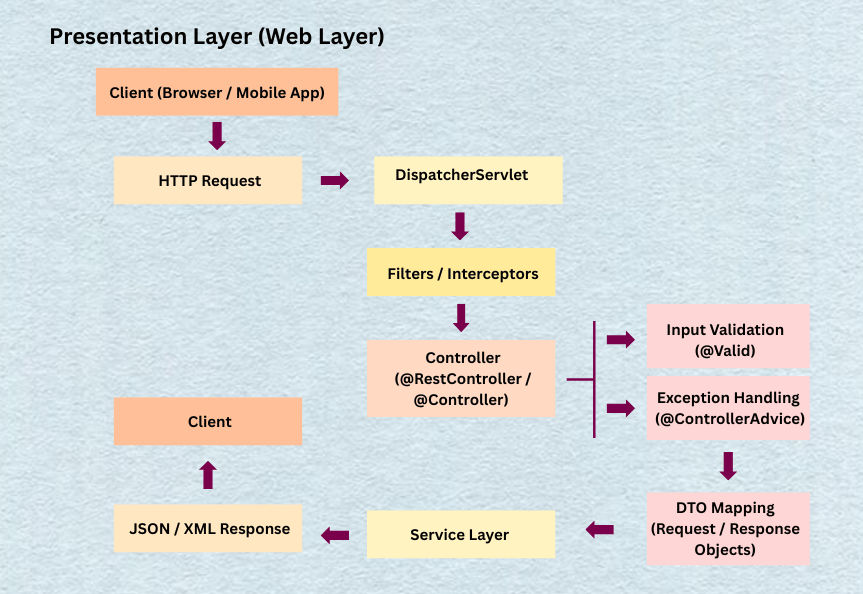
Role: Handles client interactions by receiving HTTP requests and returning responses. Acts as the entry/exit point for browsers, mobile apps, or API consumers. Validates, processes, and formats requests/responses.
Key Features:
@RestController / @Controller) define endpoints.@RequestMapping, @GetMapping, @PostMapping.@Valid / @Validated.@ControllerAdvice / @ExceptionHandler.HttpMessageConverter.Internal Mechanism:
Example:
@RestController
@RequestMapping("/api/users")
public class UserController {

    private final UserService userService;

    public UserController(UserService userService) {
        this.userService = userService;
    }

    @GetMapping("/{id}")
    public ResponseEntity<UserDTO> getUser(@PathVariable Long id) {
        return ResponseEntity.ok(userService.getUserById(id));
    }
}
Best Practices:
Role: Contains the core business logic, acting as a bridge between Presentation and Repository layers. Handles computations, validations, workflows, and orchestrates operations across multiple repositories.
Key Features:
@Service: Marks the class as a Spring-managed service component@Transactional): Ensures atomic operations and rollback on errors@Cacheable, @CachePut, @CacheEvict): Improves performanceInternal Mechanism:
Example:
@Service
public class UserService {

    private final UserRepository userRepository;

    public UserService(UserRepository userRepository) {
        this.userRepository = userRepository;
    }

    @Transactional(readOnly = true)
    public UserDTO getUserById(Long id) {
        if (id <= 0) throw new IllegalArgumentException("Invalid ID");
        User user = userRepository.findById(id)
            .orElseThrow(() -> new RuntimeException("User not found"));
        return new UserDTO(user.getId(), user.getName());
    }

    @Transactional
    public UserDTO createUser(UserDTO userDTO) {
        User user = new User(userDTO.getName(), userDTO.getEmail());
        userRepository.save(user);
        return new UserDTO(user.getId(), user.getName());
    }
}
Best Practices:
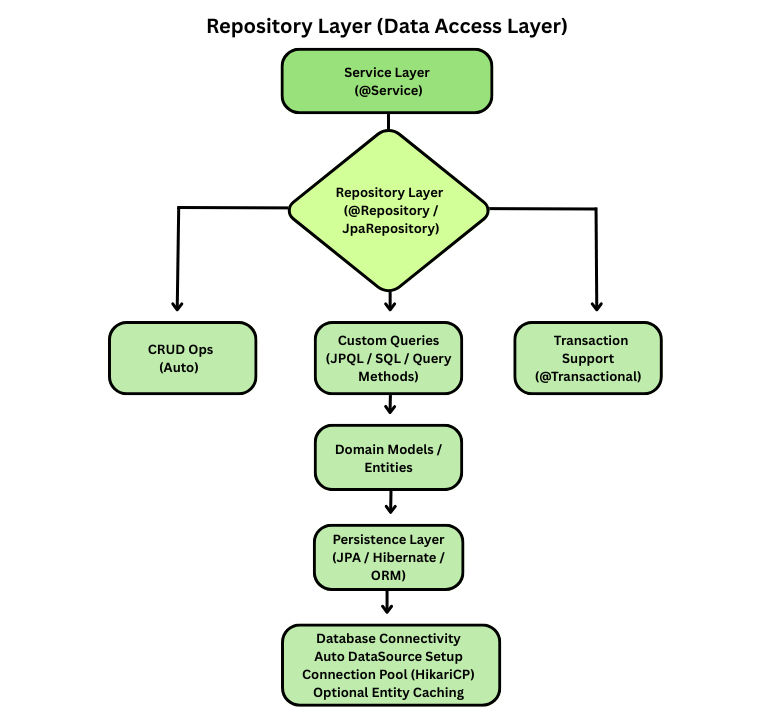
Role: Manages database operations and queries, serving as the bridge between the Service Layer and the database. It abstracts persistence logic and provides clean access to data.
Key Features:
@Repository or Spring Data JPA interfaces (JpaRepository).Internal Mechanism:
Example:
@Repository
public interface UserRepository extends JpaRepository<User, Long> {
    Optional<User> findByEmail(String email);
}
Best Practices:
Role: Stores application data permanently and provides reliable access for the Repository Layer. Handles interaction with SQL, NoSQL, or in-memory databases.
Key Features:
application.properties or application.yml.Internal Mechanism:
DataSource.EntityManagerFactory if JPA is used.Best Practices:
Example (application.properties):
spring.datasource.url=jdbc:mysql://localhost:3306/demo
spring.datasource.username=root
spring.datasource.password=secret
spring.datasource.driver-class-name=com.mysql.cj.jdbc.Driver
spring.jpa.hibernate.ddl-auto=update
spring.jpa.show-sql=true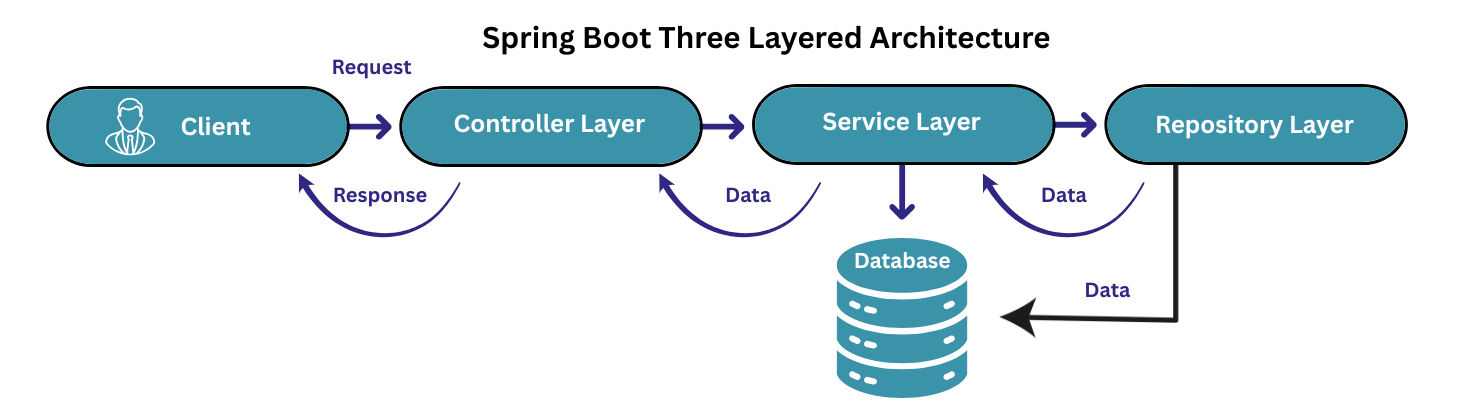
These auto-configured components work across all layers to simplify development:
| Component | Role |
|---|---|
| Auto-Configuration | Detects classpath and automatically configures beans for MVC, JPA, DataSource, Security, etc. |
| Starters | Pre-packaged dependencies (e.g., spring-boot-starter-web) to simplify project setup |
| ApplicationContext (IoC Container) | Manages beans, dependencies, and lifecycle |
| Embedded Servers | Tomcat (default), Jetty, Undertow – no external server needed |
| Logging System | Logback / Log4j2 auto-configured for dev/prod environments |
| DispatcherServlet | Front controller for routing HTTP requests to controllers |
| Event Listeners | React to application lifecycle events (e.g., ApplicationReadyEvent) |
GET /api/users/1)Diagram – Layer Interaction Flow
Client (Browser / Postman / Mobile)
           │ (HTTP Request)
           ▼
Presentation Layer (@RestController)
           │
           ▼
Service Layer (@Service – Business Logic)
           │
           ▼
Repository Layer (@Repository – Data Access)
           │
           ▼
Persistence Layer (Database)
           ▲
           │
←←←←← JSON / HTML Response ←←←←←
Spring Boot’s layered architecture—Presentation → Service → Repository → Persistence—combined with supporting components like Auto-Configuration, Starters, and Embedded Servers, ensures applications are modular, maintainable, scalable, and production-ready.
This design allows developers to build clean, testable, and enterprise-grade applications quickly, making it ideal for REST APIs, microservices, and full-stack projects.
