
Author
Spring Boot is today one of the most widely used Java frameworks, powering microservices, REST APIs, and cloud-native applications. But it didn’t appear overnight. Its journey is closely tied to the evolution of the Spring Framework, and understanding this history helps developers grasp why Spring Boot is such a game-changer.
Before Spring, Java developers struggled with:
Spring introduced concepts that became standard in modern Java development:
Spring made Java modular, testable, and flexible. But despite these advantages, manual configuration and setup were still complex and error-prone.
Even though Spring Framework was powerful, developers still faced several limitations:
These challenges highlighted the need for a faster, modern, and opinionated framework that could reduce setup time and improve productivity.
Spring Boot introduced several innovations to address the pain points of traditional Spring:
Auto-Configuration:
Automatically configures your application based on the dependencies on your classpath. No need for manual bean or server setup.
Spring Boot Starters:
Pre-packaged dependency bundles for common tasks like web, JPA, security, and testing. Developers just add a starter and all required dependencies are included.
Embedded Servers:
Applications run with Tomcat, Jetty, or Undertow embedded, so there’s no need for external server installation.
Opinionated Defaults:
Provides sensible default configurations that follow industry best practices, reducing boilerplate and setup complexity.
Result: Developers could now run applications instantly with:
java -jar myapp.jar
No XML, no manual server configuration — Spring Boot just works.
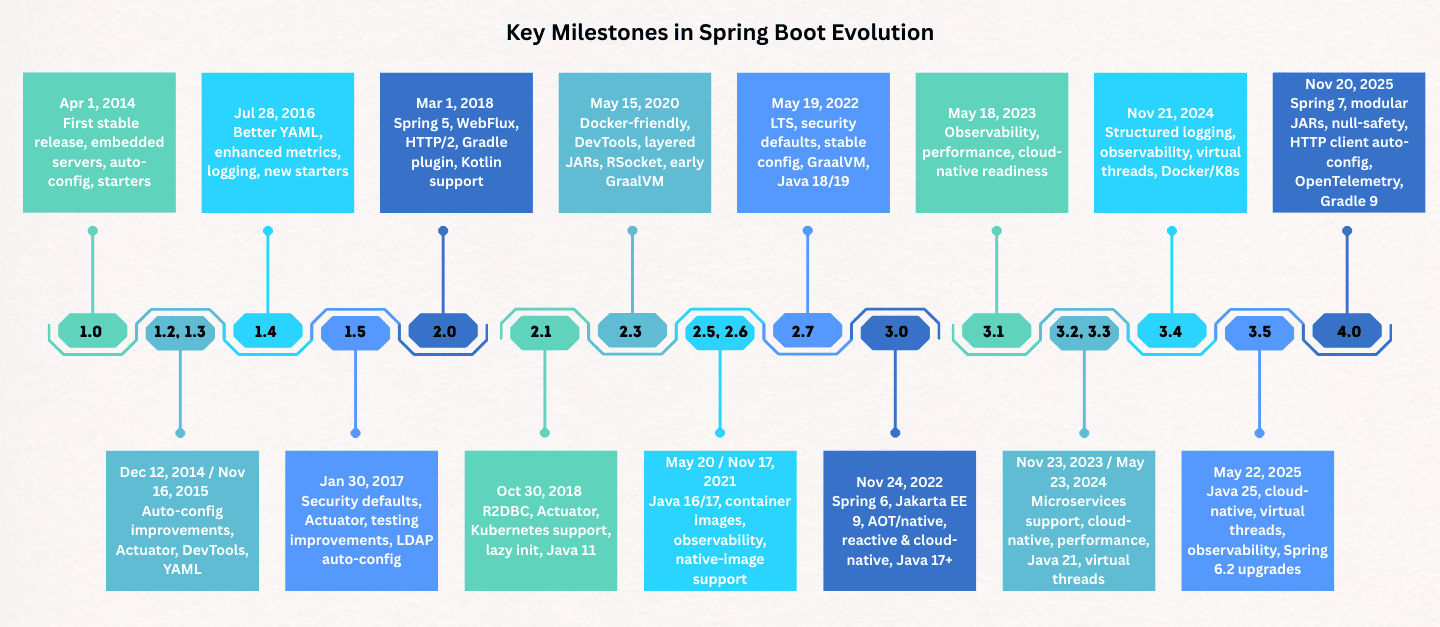
| Year | Version / Release | Release Date | Description |
|---|---|---|---|
| 2014 | Spring Boot 1.0 | April 1, 2014 | First stable release. Introduced embedded Tomcat, Jetty, Undertow support, auto-configuration, Spring Boot starters, and standalone executable applications. |
| 2014–2015 | 1.2, 1.3 | 1.2 → December 12, 2014; 1.3 → November 16, 2015 | Improvements in auto-configuration, Actuator endpoints, DevTools hot reload, testing support, YAML support, and Spring Cloud CLI integration. |
| 2016 | 1.4 | July 28, 2016 | Better YAML support, enhanced Actuator metrics, relaxed data binding, simplified logging, CLI enhancements, and new starters for caching/messaging. |
| 2017 | 1.5 | January 30, 2017 | Security defaults improved, Actuator enhancements, better testing support, production-ready integrations, LDAP auto-configuration, and improved DevTools. |
| 2018 | Spring Boot 2.0 | March 1, 2018 | Major release based on Spring Framework 5.0, full reactive support with WebFlux, HTTP/2 support, Gradle plugin, Kotlin support, and Java 8+ baseline. |
| 2018–2019 | 2.1 | October 30, 2018 | R2DBC support, improved Actuator metrics, Spring Cloud compatibility, Kubernetes foundation support, lazy initialization, Java 11 support. |
| 2020 | 2.3 | May 15, 2020 | Docker-friendly buildpacks, DevTools optimization, layered JAR support, graceful shutdown, RSocket support, Java 14 compatibility, early GraalVM native-image support. |
| 2021 | 2.5 – 2.6 | 2.5 → May 20, 2021; 2.6 → November 17, 2021 | Java 16/17 support, lightweight container images, improved observability, experimental native-image support, and HTTP/2 enhancements. |
| 2022 | 2.7 (LTS) | May 19, 2022 | Long-Term Support release. Enhanced security defaults, stable configuration system, improved Spring Native tooling, GraalVM native support, Java 18/19 compatibility. |
| 2022–2023 | Spring Boot 3.0 | November 24, 2022 | Migration to Spring Framework 6, Jakarta EE 9 namespace changes, stable AOT & native-image compilation, fully upgraded reactive & cloud-native ecosystem, Java 17+ baseline. |
| 2023–2024 | 3.1 | May 18, 2023 | Improvements in observability, performance, cloud-native readiness, and container orchestration support. |
| 2023–2024 | 3.2 – 3.3 | 3.2 → November 23, 2023; 3.3 → May 23, 2024 | Full microservices support, enhanced cloud-native features, performance improvements, security defaults, Java 21 & virtual threads support. |
| 2024 | 3.4 | November 21, 2024 | Structured logging, improved observability, virtual-thread optimizations, better Docker/Kubernetes support, and default graceful shutdown. |
| 2025 | 3.5 | May 22, 2025 | Java 25 support, improved cloud-native integrations, virtual threads, enhanced observability, upgrades to Spring Framework 6.2, Kafka, Security, Hibernate, and Tomcat. |
| 2025 | Spring Boot 4.0 | November 20, 2025 | Major release on Spring Framework 7.0, modularized JARs, Java 21+ baseline (with Java 25 support), null-safety improvements, new HTTP clients auto-configuration, API versioning, OpenTelemetry starter, Kotlin serialization module, Gradle 9 support. |
Spring Boot emerged to solve real developer pain points:
Spring Boot is the natural evolution of the Spring Framework, designed to make Java development faster, simpler, and production-ready. From its first release in 2014 to modern 3.x versions, Spring Boot has:
Today, Spring Boot is the preferred framework for developers building scalable, modern, and maintainable Java applications worldwide.
