
Author
Spring Boot is designed to fail fast during startup rather than allowing a misconfigured application to start and fail later at runtime.
Fast-fail mechanisms help developers:
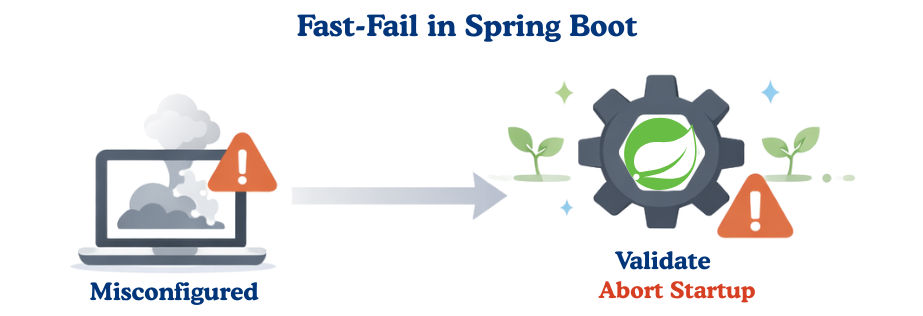
Fast-fail means:
❝ If something is misconfigured, missing, incompatible, or invalid, Spring Boot aborts startup immediately with a clear error. ❞
Instead of starting an application that will fail later, Spring Boot validates critical assumptions during startup.
| Without Fast-Fail | With Fast-Fail |
|---|---|
| App starts but crashes later | App fails immediately |
| Errors appear under load | Errors appear at startup |
| Hard to debug | Clear root cause |
| Risky production behavior | Safe deployments |
Fast-fail is essential for:
Fast-fail checks are triggered during:
SpringApplication.run()
   ↓
Environment Preparation
   ↓
ApplicationContext.refresh()
   ↓
BeanDefinition Loading
   ↓
Auto-Configuration Evaluation
   ↓
Bean Creation & Validation
Failures here stop the JVM before the app becomes ready.
1. Missing Bean / Dependency Fail-Fast
If a required dependency is missing, Spring fails immediately.
Example
@Service
publicclassOrderService {

@Autowired
private PaymentService paymentService;
}
If PaymentService bean is missing:
UnsatisfiedDependencyException:
No qualifying bean oftype'PaymentService' available
➡ Startup stops immediately.
2. Auto-Configuration Conditional Failures
Spring Boot evaluates conditions aggressively.
Example
@ConditionalOnClass(DataSource.class)
If the class is missing:
If configuration expects a DataSource but it’s not created → startup fails.
3. Configuration Property Validation (Strong Fast-Fail)
Spring Boot validates properties at startup.
Example
@ConfigurationProperties(prefix = "app")
@Validated
publicclassAppProperties {

@NotNull
private String apiKey;
}
If missing:
BindingException:
Failed to bind properties under 'app.apiKey'
➡ Application will not start.
This prevents runtime null-pointer failures.
4. Port Binding & Embedded Server Fail-Fast
If the embedded server cannot start:
Example:
Web server failed to start.
Port 8080 was already in use.
➡ JVM exits immediately.
No “half-started” application.
5. Database Connectivity Fail-Fast
By default, many starters validate database connectivity early.
Examples
Cannot determine embedded database driver class
or
Communications link failure
➡ Startup fails before serving traffic.
6. Bean Initialization Fail-Fast
Exceptions in:
@PostConstructInitializingBean.afterPropertiesSet()Example
@PostConstruct
public void init() {
    throw new IllegalStateException("Invalid state");
}
➡ Bean creation fails → context refresh aborts.
7. Circular Dependency Detection
Spring detects circular dependencies early.
Example
A → depends on B
B → depends on A
Result:
BeanCurrentlyInCreationException
➡ Startup fails instead of deadlocking.
8. Profile & Environment Validation
Spring fails fast when:
Example
spring.profiles.active=prod
But application-prod.yml is missing required keys.
➡ Startup aborts.
9. FailureAnalyzer (Clear Error Diagnostics)
Spring Boot provides FailureAnalyzer to explain startup errors.
Benefits
➡ Faster debugging during startup failures
10. ApplicationContext Refresh Abort
If any critical error occurs during context refresh:
➡ Entire application startup is cancelled
➡ No partial or unstable state
11. Debug & Condition Evaluation Reports
Enable:
debug=true
Shows:
➡ Transparent startup diagnostics
Fast-fail is only useful if errors are observable and diagnosable.
Spring Boot provides powerful startup diagnostics.
1. FailureAnalyzer (Human-Readable Errors)
Spring Boot converts low-level exceptions into actionable messages.
Example:
***************************
APPLICATION FAILED TO START
***************************

Description:
Port 8080 was already in use.

Action:
Stop the process using the port or configure a different port.
2. Condition Evaluation Report
Enable diagnostic mode:
debug=true
Shows:
Example output:
DataSourceAutoConfiguration:
- @ConditionalOnClass found required classes
- @ConditionalOnProperty did not find property
3. Startup Stack Traces (Root Cause Visibility)
Spring prints:
This prevents silent misconfiguration.
4. Actuator Startup Metrics
With Spring Boot Actuator enabled:
/actuator/startup
Provides:
Useful for diagnosing slow or failing startups.
Modern backend systems must decide how to react when something goes wrong at startup.
Spring Boot supports both fail-fast and fail-safe approaches—but uses them intentionally and selectively.
| Aspect | Fail-Fast | Fail-Safe |
|---|---|---|
| Startup Behavior | Application fails immediately | Application starts with reduced functionality |
| Safety | High (prevents broken apps from running) | Risky (errors appear at runtime) |
| Error Detection | Early (during startup) | Late (under load or specific paths) |
| Debugging | Easy – clear root cause | Hard – failures are intermittent |
| User Impact | No traffic served | Partial / unpredictable behavior |
| Recommended For | Core infrastructure (DB, messaging, security, config) | Optional / non-critical features (metrics, optional integrations) |
Spring Boot defaults to fail-fast for critical infrastructure.
Fail-fast configuration ensures that critical dependencies are validated during startup, preventing applications from running in an inconsistent or broken state.
Spring Boot encourages fail-fast for infrastructure and conditional activation for optional features.
Critical external systems should block startup if unavailable.
Example: Spring Cloud Config Server
spring.cloud.config.fail-fast=true
Application will not start if config server is unreachable.
Fail-fast can be combined with retries:
spring.cloud.config.retry.max-attempts=5
spring.cloud.config.retry.initial-interval=2000
spring.cloud.config.fail-fast=true
Behavior:
Optional or non-critical features should not block startup.
Example: Feature Toggle
@ConditionalOnProperty(
    name = "feature.enabled",
    havingValue = "true",
    matchIfMissing = false
)
Behavior:
@PostConstructThese defeat fast-fail guarantees.
Fast-fail enables:
A failing pod is better than a broken pod serving traffic.
Fast-Fail is a design philosophy, not just an error mechanism.
Spring Boot’s startup engine is intentionally strict:
