What is Spring Framework?
Spring Framework is a powerful and widely used Java framework for building enterprise-level applications efficiently.
It helps developers by providing:
1. Dependency Injection (DI)
- Helps loosen the coupling between classes.
- Makes code easier to test, maintain, and scale.
2. Aspect-Oriented Programming (AOP)
- Handles cross-cutting concerns like logging, security, and transactions.
- Keeps business logic separate from system-level code.
3. Spring MVC (Model-View-Controller)
- Framework to build web applications efficiently.
- Supports REST APIs, templates, and form handling.
4. Transaction Management
- Simplifies database operations.
- Ensures data consistency and reliability across multiple operations.
5. Lightweight Container
- Spring provides a lightweight IoC container to manage objects (beans) and their lifecycle.
- Reduces boilerplate code and simplifies setup.
6. Integration Support
- Integrates easily with ORM frameworks like Hibernate, JPA, and MyBatis.
- Supports messaging, caching, and batch processing.
7. Testing Support
- Built-in support for unit testing and integration testing.
- Makes writing testable code easy and fast.
In simple words: Spring is like a toolbox for Java developers—it gives all the tools needed to build scalable, maintainable, and high-quality applications without writing everything from scratch.
Limitations of Spring Framework
Although Spring Framework is powerful and widely used, it has some drawbacks that can make development slower and more complex, especially for beginners:
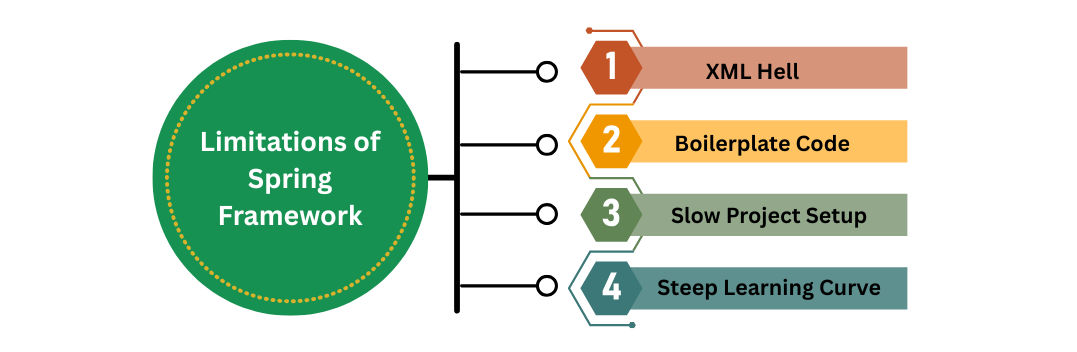
1. XML Hell
- Traditional Spring requires long XML configuration files for beans, MVC setup, database connections, and more.
- Managing multiple XML files in a large project becomes confusing and error-prone.
2. Boilerplate Code
- Developers often write repetitive code for configuration, dependency injection, and wiring.
- This increases development time and adds unnecessary complexity.
3. Slow Project Setup
- Creating a Spring project involves multiple steps: configuring server, dependencies, database, and MVC.
- Beginners may spend hours or even days before they can start writing actual business logic.
4. Steep Learning Curve
- Understanding dependency injection, AOP, transactions, and MVC can be challenging for beginners.
- New developers may feel overwhelmed with framework concepts and configurations.
Why This Matters
Traditional Spring is powerful but complex. Beginners often get stuck in XML configurations and boilerplate code, which can slow down learning and productivity.
This is exactly why Spring Boot was created — to remove these hurdles and make Java development fast, easy, and modern.
Conclusion:
Spring Framework is powerful but complex, with XML configurations, boilerplate code, and slow setup.
Spring Boot solves these issues with auto-configuration, starter dependencies, and embedded servers, making Java development faster, easier, and production-ready.
- Spring Framework = powerful but complex
- Limitations = XML hell, boilerplate code, slow setup
- Spring Boot = fast, modern, and beginner-friendly solution

