
Author
Docker Volumes are used to store and manage data outside containers, ensuring that your data remains safe even if a container stops or is removed.
By default, containers are temporary (ephemeral). This means any data stored inside a container is lost once it is deleted.
Docker Volumes solve this problem by providing persistent storage that exists independently of containers.
? In simple words: Docker Volumes keep your data safe even when containers are destroyed.
Docker Volumes are essential when working with real-world applications that need reliable data storage.
? In simple terms: Docker Volumes help you store, share, and protect your data efficiently.

Named volumes are managed completely by Docker.
docker volume create my_volume

docker run -d \\
  -v my_volume:/app/data \\
  nginx
Bind mounts connect a host directory directly to a container.
docker run -d \\
  -v /host/data:/app/data \\
  nginx
Anonymous volumes are created automatically by Docker without a specific name.
docker run -d \\
  -v /app/data \\
  nginx
Docker Volumes follow a simple process to store data outside the container:
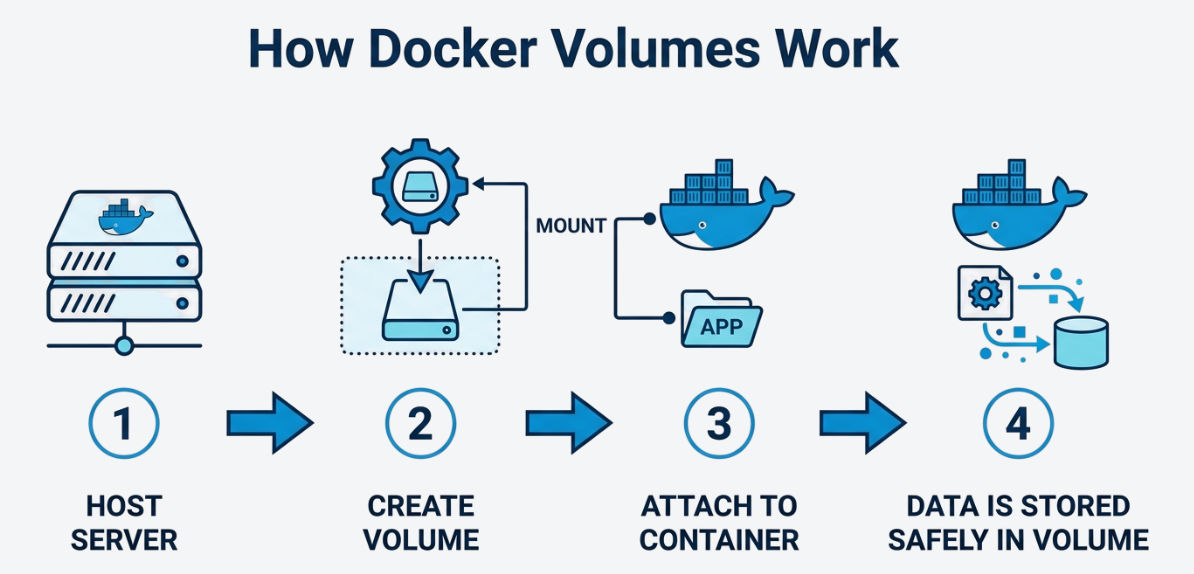
docker run -d \\
  -v my_volume:/usr/share/nginx/html \\
  nginx
? Any data written inside /usr/share/nginx/html will be stored in the volume and will persist even after container removal.
docker volume create my_volume     # Create volume
docker volume ls                   # List volumes
docker volume inspect my_volume    # View volume details
docker volume rm my_volume         # Remove volume
docker volume prune                # Remove unused volumes
| Feature | Volume | Bind Mount |
|---|---|---|
| Managed by | Docker | User (Host OS) |
| Location | Docker storage | Any host directory |
| Portability | High | Low |
| Performance | Optimized | Depends on host |
| Use Case | Production | Development |
docker volume pruneDocker Volumes provide a reliable and efficient way to store data outside containers, ensuring that important data is not lost when containers are removed.
They improve performance, enable data sharing, and help build stable, scalable, and production-ready applications by separating data from the application lifecycle.
