
Author
Enums are one of the most powerful and clean ways to represent fixed sets of constants in Java. They improve readability, remove hard-coded values, and make your code type-safe.
An enum (short for enumeration) is a special data type in Java that defines a fixed set of named constants.
It is used when you know all the possible values at compile time.
Example:
enum Day {
    MONDAY, TUESDAY, WEDNESDAY, THURSDAY, FRIDAY, SATURDAY, SUNDAY
}
Enums make your code:
public static final constantsInternally, every enum:
When you write:
enum Color { RED, GREEN }
Internally, Java converts it roughly to:
final class Color extends Enum<Color> {
    public static final Color RED = new Color("RED", 0);
    public static final Color GREEN = new Color("GREEN", 1);
}
Each constant becomes a public static final object of the enum type.
enum Color {
    RED, GREEN, BLUE
}

public class Test {
    public static void main(String[] args) {
        Color c = Color.RED;
        System.out.println(c);   // Output: RED
    }
}
Enums work beautifully with switch-case.
enum Day { MONDAY, FRIDAY, SUNDAY }

switch (Day.FRIDAY) {
    case MONDAY:
        System.out.println("Start of week");
        break;
    case FRIDAY:
        System.out.println("Weekend is coming!");
        break;
    case SUNDAY:
        System.out.println("Weekend!");
        break;
}
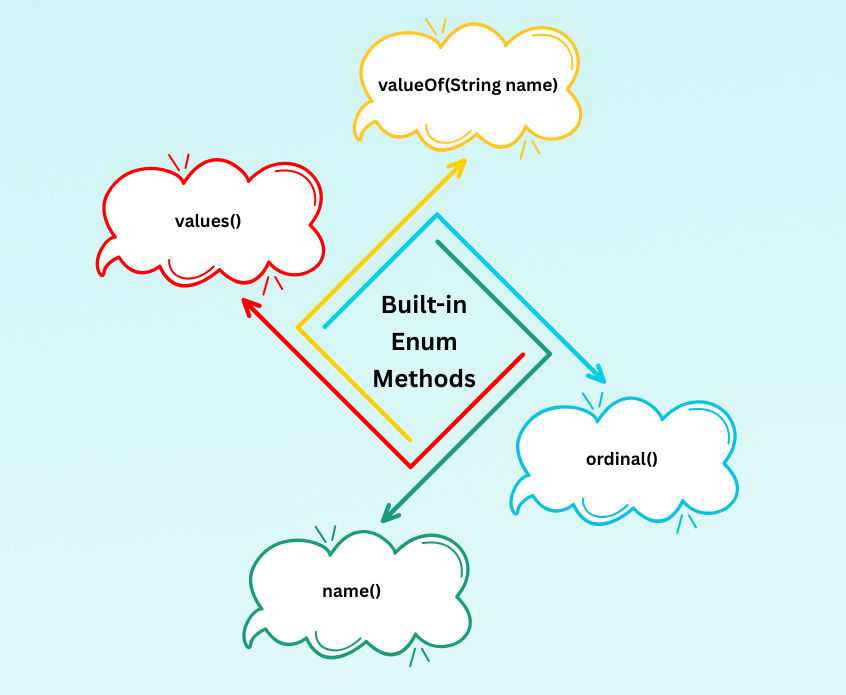
Java provides useful methods for all enums:
| Method | Description |
|---|---|
values() |
Returns all enum constants |
valueOf(String name) |
Returns constant with given name |
ordinal() |
Returns index (0-based) |
name() |
Returns constant name |
for (Day d : Day.values()) {
    System.out.println(d + " - Index: " + d.ordinal());
}
Enums can behave like classes.
Example: Enum with Field and Constructor
enum Status {
    SUCCESS(200),
    ERROR(500),
    NOT_FOUND(404);

    private int code;

    Status(int code) {
        this.code = code;  // private constructor
    }

    public int getCode() {
        return code;
    }
}
Usage:
System.out.println(Status.SUCCESS.getCode()); // Output: 200
enum Level {
    LOW {
        @Override
        public String message() {
            return "Low Level";
        }
    },
    HIGH {
        @Override
        public String message() {
            return "High Level";
        }
    };

    public abstract String message();
}
interface Printable {
    void print();
}

enum Color implements Printable {
    RED, GREEN;

    public void print() {
        System.out.println("Color: " + this.name());
    }
}
Example:
enum OrderStatus {
    PENDING, PROCESSING, SHIPPED, DELIVERED, CANCELLED
}
