
Author
Immutable collections are collections that cannot be modified after creation. Once you create them, you cannot add, remove, or change elements.
Java 9 introduced new convenient factory methods to create immutable List, Set, and Map objects easily and safely.
An immutable collection is a collection whose elements cannot be added, removed, or updated once it is created.
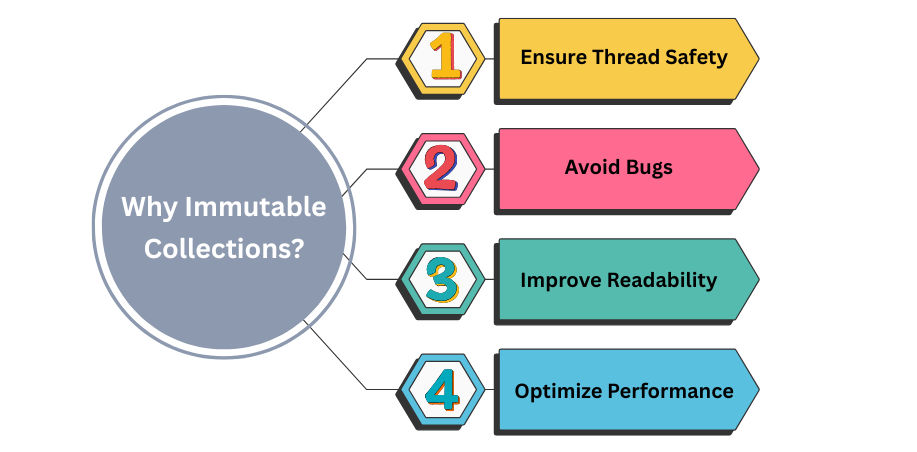
Immutable collections are useful because they:
Java 9 introduced factory methods in List, Set, and Map interfaces to create immutable collections:
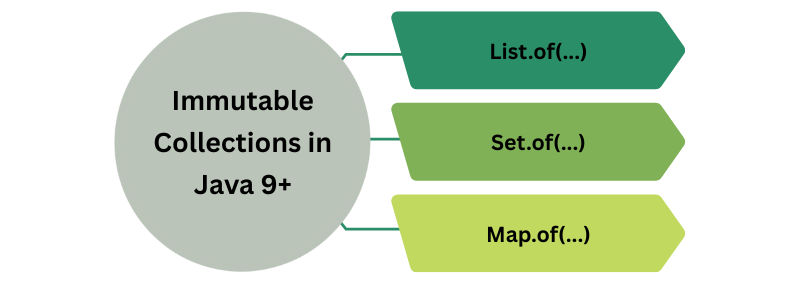
List.of(...)Set.of(...)Map.of(...)1. Immutable List
import java.util.List;

public class Main {
    public static void main(String[] args) {
        List<String> list = List.of("A", "B", "C");

        System.out.println(list); // [A, B, C]

        // list.add("D"); //  Throws UnsupportedOperationException
        // list.remove("A"); //  Throws UnsupportedOperationException
    }
}
Key Points:
null elements (throws NullPointerException)2. Immutable Set
import java.util.Set;

public class Main {
    public static void main(String[] args) {
        Set<String> set = Set.of("X", "Y", "Z");

        System.out.println(set); // [X, Y, Z]

        // set.add("A"); //  UnsupportedOperationException
    }
}
Key Points:
null3. Immutable Map
import java.util.Map;

public class Main {
    public static void main(String[] args) {
        Map<Integer, String> map = Map.of(1, "One", 2, "Two", 3, "Three");

        System.out.println(map); // {1=One, 2=Two, 3=Three}

        // map.put(4, "Four"); //  UnsupportedOperationException
    }
}
Key Points:
null keys or values are not allowedFor more than 10 entries, use:
Map<Integer, String> map = Map.ofEntries(
    Map.entry(1, "One"),
    Map.entry(2, "Two"),
    Map.entry(3, "Three")
);
For maps with more than 10 entries, use Map.ofEntries():
Map<String, Integer> scores = Map.ofEntries(
    Map.entry("Alice", 90),
    Map.entry("Bob", 85),
    Map.entry("Charlie", 92)
);
| Feature | Java 8 | Java 9+ |
|---|---|---|
| Creation | Collections.unmodifiableList(...) |
List.of(...) |
| Nulls | Allows nulls | NullPointerException for null elements |
| Conciseness | Verbose | Concise & readable |
| Performance | Extra wrapper object | Optimized built-in immutable objects |
Collections.unmodifiable*() vs List.of()List<String> fruits = new ArrayList<>();
fruits.add("Apple");
fruits.add("Banana");
List<String> unmodifiableFruits = Collections.unmodifiableList(fruits);
List<String> fruits = List.of("Apple", "Banana");
// Truly immutable and concise
List.of, Set.of, Map.of) instead of Collections.unmodifiableListImmutable Collections (Java 9+):
List.of, Set.of, Map.of