
Author
ConcurrentNavigableSet is a thread-safe, sorted, and navigable Set interface introduced in Java 6.
It extends NavigableSet and adds support for concurrent access without external synchronization.
It belongs to:
java.util.concurrent package.
It is a sorted set that supports:
ceiling, floor, subSet, headSet, etc.)It is similar to TreeSet, but:
Iterable
   │
Collection
   │
Set
   │
SortedSet
   │
NavigableSet
   │
ConcurrentNavigableSet   ← Interface
         │
         └── Implemented By:
                └── ConcurrentSkipListSet (Class)
Only concrete implementation → ConcurrentSkipListSet
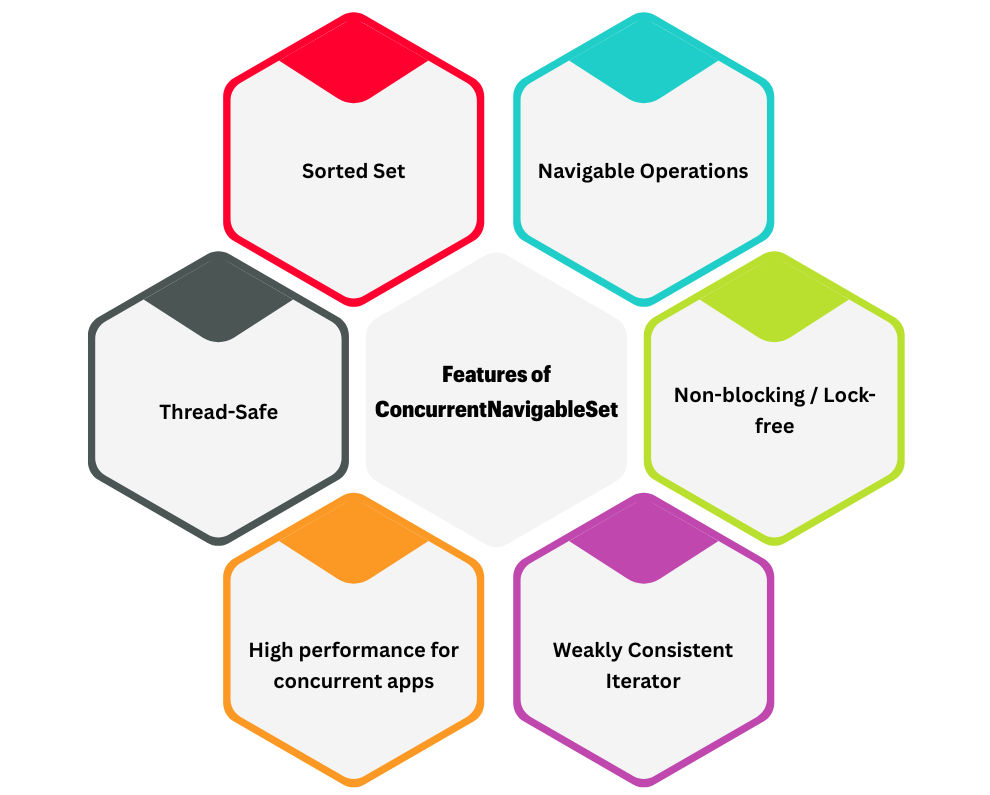
1. Thread-Safe
Multiple threads can read/write simultaneously.
2. Sorted Set
Maintains ascending order (or custom comparator).
3. Navigable Operations
Includes:
ceiling(E e)floor(E e)higher(E e)lower(E e)subSet(E from, E to)headSet(E toElement)tailSet(E fromElement)4. Non-blocking / Lock-free
Internally uses ConcurrentSkipListMap → skip-list based.
5. Weakly Consistent Iterator
Iterator:
ConcurrentModificationException6. High performance for concurrent apps
Better than synchronized TreeSet.
| Method | Description |
|---|---|
add(E e) |
Adds an element if not already present |
remove(Object o) |
Removes an element |
contains(Object o) |
Checks if an element exists |
size() |
Returns number of elements |
isEmpty() |
Checks if set is empty |
first() |
Returns the first (lowest) element |
last() |
Returns the last (highest) element |
lower(E e) |
Greatest element < e |
floor(E e) |
Greatest element ≤ e |
ceiling(E e) |
Smallest element ≥ e |
higher(E e) |
Smallest element > e |
pollFirst() |
Removes and returns the first element |
pollLast() |
Removes and returns the last element |
iterator() |
Returns iterator in ascending order |
descendingIterator() |
Returns iterator in descending order |
subSet(E from, boolean fromInclusive, E to, boolean toInclusive) |
Returns a subset view |
headSet(E to, boolean inclusive) |
Returns head set view |
tailSet(E from, boolean inclusive) |
Returns tail set view |
import java.util.concurrent.ConcurrentNavigableSet;
import java.util.concurrent.ConcurrentSkipListSet;

public class Main {
    public static void main(String[] args) {
        ConcurrentNavigableSet<Integer> set = new ConcurrentSkipListSet<>();

        set.add(10);
        set.add(30);
        set.add(20);
        set.add(40);

        System.out.println("Set: " + set);

        // Navigable methods
        System.out.println("Lower than 25: " + set.lower(25));   // 20
        System.out.println("Floor of 30: " + set.floor(30));     // 30
        System.out.println("Ceiling of 25: " + set.ceiling(25)); // 30
        System.out.println("Higher than 30: " + set.higher(30)); // 40

        // Polling elements
        System.out.println("Poll First: " + set.pollFirst());    // 10
        System.out.println("Poll Last: " + set.pollLast());      // 40

        System.out.println("Updated Set: " + set);
    }
}
Output:
Set: [10, 20, 30, 40]
Lower than 25: 20
Floor of 30: 30
Ceiling of 25: 30
Higher than 30: 40
Poll First: 10
Poll Last: 40
Updated Set: [20, 30]
Backed by a skip-list data structure
(multi-level linked structure for fast searching)
Ordered keys like TreeMap
But operations are lock-free or minimal-lock
Skiplist complexity:
| Operation | Time |
|---|---|
| add() | O(log n) |
| remove() | O(log n) |
| contains() | O(log n) |
It is an interface → you use ConcurrentSkipListSet.
Example
ConcurrentNavigableSet<Integer> set =
        new ConcurrentSkipListSet<>();
ConcurrentNavigableSet<Integer> set =
        new ConcurrentSkipListSet<>();

set.add(10);
set.add(20);
set.add(30);
set.add(40);

System.out.println(set.subSet(10, 30));   // [10, 20]
System.out.println(set.headSet(30));      // [10, 20]
System.out.println(set.tailSet(20));      // [20, 30, 40]
Use it when you need:
Perfect for:
| Feature | TreeSet | ConcurrentNavigableSet |
|---|---|---|
| Thread-safe | No | Yes |
| Fail-safe iterator | No | Yes (weakly consistent) |
| Backed by | Red-black tree | Skip-list |
| Best for | Single-thread | Multi-thread |
| Order | Sorted | Sorted + navigable |
ConcurrentNavigableSet = Thread-safe, sorted, and navigable set backed by ConcurrentSkipListSet.
