
Author
The Java Concurrency API is one of the most important parts of modern Java programming. It allows Java applications to run multiple tasks at the same time, making them faster, more scalable, and more efficient.
Today’s Java applications such as web applications, backend services, microservices, and enterprise systems depend heavily on the Java Concurrency API to handle many users and operations at once.
Concurrency in Java means executing multiple tasks at the same time instead of running them one by one. Java achieves concurrency using threads, allowing better use of CPU resources.
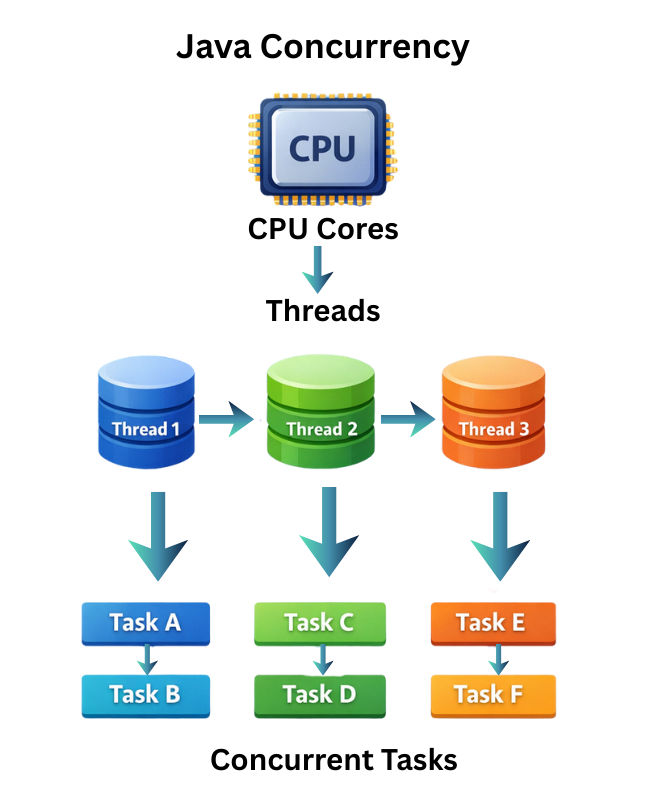
Concurrency helps to:
The Java Concurrency API is a collection of powerful classes and interfaces available mainly in:
java.util.concurrent
It provides higher-level utilities compared to basic Thread and synchronized, which are often hard to use correctly.
The Concurrency API makes multithreading:
Using the Java Concurrency API helps developers to:
Without this API, handling concurrency becomes complex and risky.
Java provides several powerful components for building fast, safe, and scalable multithreaded applications.
Below are the main components of the Java Concurrency API, explained simply.
The Executor Framework manages thread creation and lifecycle automatically. Developers only focus on what task to run, not how threads are created.
import java.util.concurrent.ExecutorService;
import java.util.concurrent.Executors;

public class ExecutorExample {
    public static void main(String[] args) {
        // Create a thread pool with 3 threads
        ExecutorService executor = Executors.newFixedThreadPool(3);

        // Submit 5 tasks
        for (int i = 1; i <= 5; i++) {
            int taskId = i;
            executor.submit(() -> {
                System.out.println("Executing Task " + taskId + " by " + Thread.currentThread().getName());
            });
        }

        executor.shutdown(); // Stop accepting new tasks
    }
}
Key Components
Common Use Cases
Concurrent Collections are thread-safe collections designed for multithreaded environments. They are more scalable than synchronized collections.
import java.util.concurrent.ConcurrentHashMap;

public class ConcurrentMapExample {
    public static void main(String[] args) {
        ConcurrentHashMap<String, Integer> map = new ConcurrentHashMap<>();

        // Multiple threads updating map safely
        Thread t1 = new Thread(() -> map.put("A", 1));
        Thread t2 = new Thread(() -> map.put("B", 2));

        t1.start();
        t2.start();

        try {
            t1.join();
            t2.join();
        } catch (InterruptedException e) {
            e.printStackTrace();
        }

        System.out.println("Map Content: " + map);
    }
}
Common Concurrent Collections
Advantages
Locks and synchronizers provide advanced control over thread synchronization compared to the synchronized keyword.
import java.util.concurrent.locks.Lock;
import java.util.concurrent.locks.ReentrantLock;

public class LockExample {
    private static int counter = 0;
    private static Lock lock = new ReentrantLock();

    public static void main(String[] args) throws InterruptedException {
        Runnable task = () -> {
            lock.lock(); // Acquire lock
            try {
                counter++;
                System.out.println("Counter: " + counter + " by " + Thread.currentThread().getName());
            } finally {
                lock.unlock(); // Release lock
            }
        };

        Thread t1 = new Thread(task);
        Thread t2 = new Thread(task);

        t1.start();
        t2.start();

        t1.join();
        t2.join();
    }
}
Common Classes
Advantages:
Atomic variables provide thread-safe operations without using explicit locks. They are part of the package:
java.util.concurrent.atomic
These variables are lock-free, meaning multiple threads can safely update them without risking data inconsistency or deadlocks.
Example:
import java.util.concurrent.atomic.AtomicInteger;

public class AtomicExample {
    private static AtomicInteger atomicCounter = new AtomicInteger(0);

    public static void main(String[] args) throws InterruptedException {
        Runnable task = () -> {
            atomicCounter.incrementAndGet();
            System.out.println("Atomic Counter: " + atomicCounter.get() + " by " + Thread.currentThread().getName());
        };

        Thread t1 = new Thread(task);
        Thread t2 = new Thread(task);

        t1.start();
        t2.start();

        t1.join();
        t2.join();
    }
}
Common atomic classes:
AtomicInteger – Integer valuesAtomicLong – Long valuesAtomicBoolean – Boolean flagsAtomicReference<T> – Object referencesAdvantages:
The Fork/Join Framework is designed for tasks that can be broken into smaller subtasks and processed in parallel.
import java.util.concurrent.RecursiveTask;
import java.util.concurrent.ForkJoinPool;

class SumTask extends RecursiveTask<Integer> {
    private int[] numbers;
    private int start, end;

    public SumTask(int[] numbers, int start, int end) {
        this.numbers = numbers;
        this.start = start;
        this.end = end;
    }

    @Override
    protected Integer compute() {
        if (end - start <= 2) { // small task
            int sum = 0;
            for (int i = start; i < end; i++) sum += numbers[i];
            return sum;
        } else {
            int mid = (start + end) / 2;
            SumTask left = new SumTask(numbers, start, mid);
            SumTask right = new SumTask(numbers, mid, end);
            left.fork(); // async
            return right.compute() + left.join(); // combine
        }
    }
}

public class ForkJoinExample {
    public static void main(String[] args) {
        int[] numbers = {1, 2, 3, 4, 5};
        ForkJoinPool pool = new ForkJoinPool();
        int result = pool.invoke(new SumTask(numbers, 0, numbers.length));
        System.out.println("Sum: " + result);
    }
}
How It Works
Key Features
Best Use Cases
Parallel Streams allow collections to be processed using multiple threads automatically.
import java.util.Arrays;

public class ParallelStreamExample {
    public static void main(String[] args) {
        int[] numbers = {1, 2, 3, 4, 5};

        int sum = Arrays.stream(numbers)
                        .parallel() // process in parallel
                        .map(n -> n * 2)
                        .sum();

        System.out.println("Sum of doubled numbers: " + sum);
    }
}
Benefits
Caution
They improve performance for large datasets but must be used carefully to avoid overhead and blocking issues.
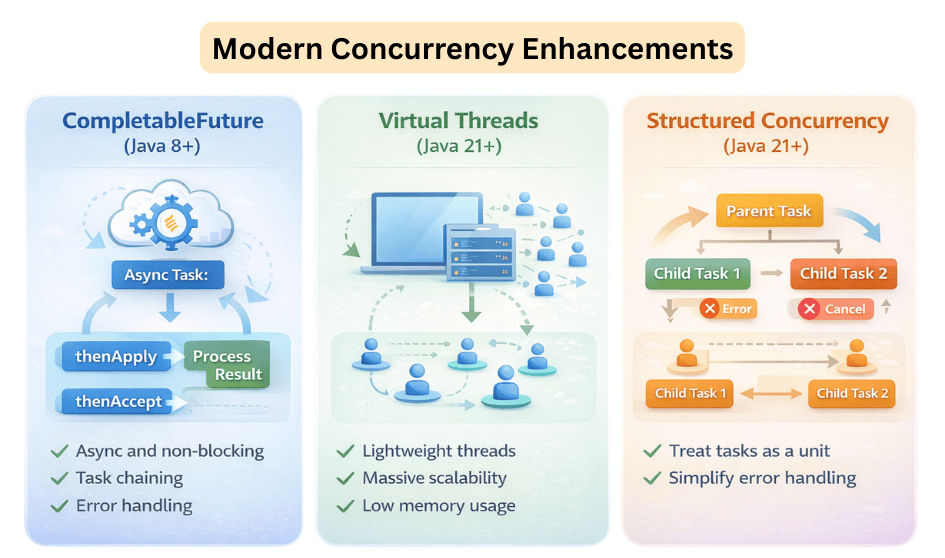
Recent Java versions introduced advanced concurrency features to simplify multithreading, improve scalability, and reduce boilerplate code.
a) CompletableFuture (Java 8+)
CompletableFuture allows asynchronous, non-blocking programming with easy task chaining and error handling.
Example:
import java.util.concurrent.CompletableFuture;

publicclassCompletableFutureExample {
publicstaticvoidmain(String[] args) {
        CompletableFuture.supplyAsync(() ->"Hello")
                .thenApply(s -> s +" World")// Transform result
                .thenAccept(System.out::println);// Consume result

// Small delay to allow async output
try { Thread.sleep(500); }catch (InterruptedException e) {}
    }
}
Key Features:
thenApply, thenAccept, etc.)exceptionally)b) Virtual Threads (Java 21+)
Virtual Threads are lightweight threads that reduce the overhead of traditional OS threads.
Benefits:
Example Use Case: Handling thousands of simultaneous client connections in a web server without thread pool tuning.
c) Structured Concurrency (Java 21+)
Structured Concurrency treats a group of related tasks as a single unit, making concurrent code easier to write and maintain.
Benefits:
Example Use Case: Running multiple parallel service calls in a microservice and combining results safely.
The Java Concurrency API provides powerful tools that make multithreaded programming easier, safer, and more efficient. Below are the key benefits explained in simple words:
The Java Concurrency API is widely used in modern software systems where performance, scalability, and reliability are critical.
The Java Concurrency API is essential for modern Java development. It simplifies multithreading and parallel processing, enabling developers to:
Tools like the Executor Framework, Concurrent Collections, Locks, Atomic Variables, Fork/Join Framework, Parallel Streams, CompletableFuture, and Virtual Threads make building fast, scalable, and reliable applications easier than ever.
