
Author
In multithreaded applications, threads often need to coordinate, wait for certain conditions, or exchange data safely. Java provides synchronizers in the java.util.concurrent package to handle these scenarios efficiently.
Synchronizers help control thread execution without low-level wait()/notify() methods, making concurrent programming safer, easier, and faster.
Synchronizers are concurrency utilities that help threads coordinate their actions. They build on locks but provide higher-level abstractions such as counting, barriers, and signaling.
Think of them like traffic signals for threads—they determine when a thread can proceed and when it must wait.
Java provides high-level synchronizers in the java.util.concurrent package to coordinate threads safely and efficiently.
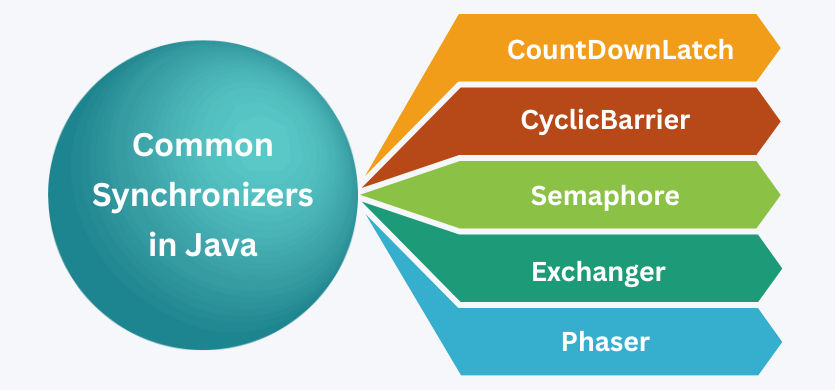
countDown().await() wait until the count reaches zero.Example:
import java.util.concurrent.CountDownLatch;

CountDownLatch latch = new CountDownLatch(3);

Runnable task = () -> {
    System.out.println(Thread.currentThread().getName() + " finished work");
    latch.countDown();
};

new Thread(task).start();
new Thread(task).start();
new Thread(task).start();

latch.await(); // Main thread waits
System.out.println("All tasks completed!");
Example:
import java.util.concurrent.CyclicBarrier;

CyclicBarrierbarrier=newCyclicBarrier(3,
    () -> System.out.println("All threads reached the barrier"));

Runnabletask= () -> {
    System.out.println(Thread.currentThread().getName() +" is waiting at barrier");
    barrier.await();// Wait for other threads
    System.out.println(Thread.currentThread().getName() +" passed barrier");
};
acquire() and release it with release().Example:
import java.util.concurrent.Semaphore;

Semaphoresemaphore=newSemaphore(2);// Only 2 threads allowed concurrently

Runnabletask= () -> {
    semaphore.acquire();
try {
        System.out.println(Thread.currentThread().getName() +" is working");
        Thread.sleep(2000);
    }finally {
        semaphore.release();
    }
};
Example:
import java.util.concurrent.Exchanger;

Exchanger<String> exchanger =newExchanger<>();

Runnabletask1= () -> {
Stringdata="Data from Thread1";
Stringreceived= exchanger.exchange(data);
    System.out.println(Thread.currentThread().getName() +" received: " + received);
};

Runnabletask2= () -> {
Stringdata="Data from Thread2";
Stringreceived= exchanger.exchange(data);
    System.out.println(Thread.currentThread().getName() +" received: " + received);
};
Example:
import java.util.concurrent.Phaser;

Phaserphaser=newPhaser(3);

phaser.arriveAndAwaitAdvance();// Wait for all parties at this phase
wait() and notify()| Synchronizer | Main Purpose | Use Case |
|---|---|---|
| CountDownLatch | Wait for multiple threads to finish | Initialization, batch completion |
| CyclicBarrier | Wait for threads at a barrier | Phase-wise task coordination |
| Semaphore | Limit concurrent access | Database connections, API calls |
| Exchanger | Exchange data between two threads | Data swapping, producer-consumer |
| Phaser | Multi-phase coordination | Complex multi-step workflows |
Java synchronizers are powerful tools for thread coordination and control.
Synchronizers make multithreaded programming simpler, safer, and more efficient, especially in high-concurrency applications.
