
Durgesh Tiwari
Author
Clean Code Principles are a collection of best practices used to write code that is clear, readable, maintainable, and easy to modify. Clean code helps developers build professional software that remains understandable even as projects grow larger.
In simple words: Clean code means writing code that developers can easily read, understand, and maintain.
Clean code is code that is simple, organized, and free from unnecessary complexity. It should clearly communicate the developer’s intention without requiring excessive explanation.
Good clean code should:
Be easy to understand
Use meaningful names
Avoid unnecessary duplication
Be simple to maintain and test
Follow consistent coding standards
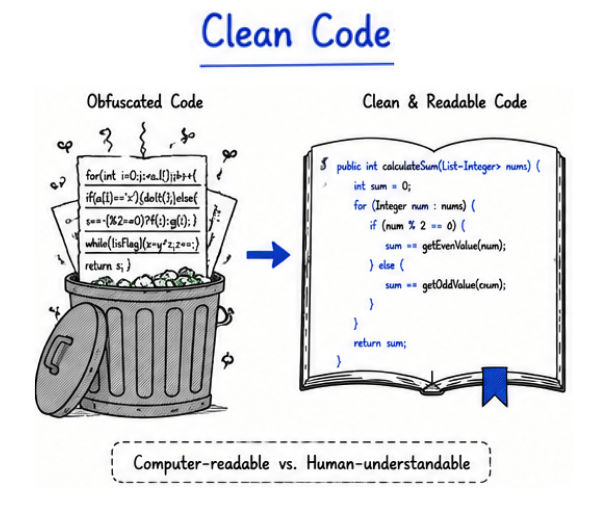
👉 Clean code focuses on readability and long-term maintainability, not just making the program work.
In real-world software development, applications are often maintained by multiple developers over many years. Poorly written code becomes difficult to understand, debug, and extend.
Benefits of Clean Code
Improves code readability
Makes debugging and testing easier
Reduces maintenance effort and cost
Improves collaboration between developers
Helps identify issues more quickly
Makes applications easier to scale and modi
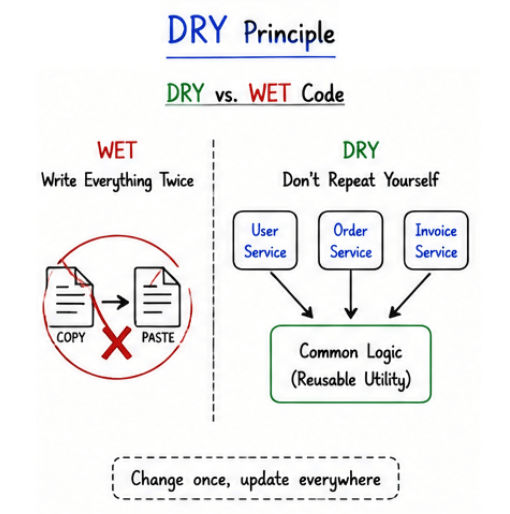
The DRY principle states that the same logic or code should not be repeated in multiple places within an application.
Common functionality should be reused through methods, classes, utilities, or shared modules.
Problem Without DRY
Suppose the same validation logic is written separately in multiple classes.
If validation rules change later, developers must update the same code everywhere, increasing maintenance effort and the risk of errors.
Without DRY
void validateCustomerEmail(String email) {
    // email validation logic
}

void validateAdminEmail(String email) {
    // same email validation logic repeated
}
Following DRY
class ValidationUtil {

    static boolean isValidEmail(String email) {
        // email validation logic
        return true;
    }
}
if (ValidationUtil.isValidEmail(email)) {
    // proceed further
}
Validation logic is written once and reused wherever needed.
In enterprise applications, functionalities such as:
Input validation
Logging
Authentication
Error handling
are often implemented once and reused across multiple modules.
👉 DRY improves maintainability, reduces duplication, and keeps applications cleaner and easier to manage.
Benefits
Reduces duplicate code
Simplifies maintenance
Reduces the chances of bugs
Improves code reusability
Makes applications easier to scale and modify
The KISS principle states that code should be simple, clear, and easy to understand.
Avoid writing unnecessarily complex logic when a simpler solution is enough.
Problem Without KISS
Overcomplicated code with deep nesting and confusing logic becomes difficult to debug, test, and maintain.
Complex Approach
if (user != null) {
    if (user.isActive()) {
        accessDashboard();
    }
}
Simple Approach
if (user != null && user.isActive()) {
    accessDashboard();
}
Simpler solutions improve readability and reduce maintenance effort.
Benefits
Improves code readability
Makes debugging easier
Simplifies maintenance
Speeds up the development process
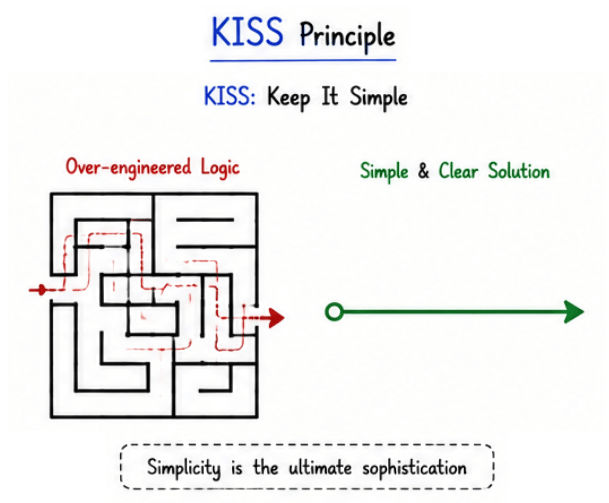
👉 Simple code is easier for teams to understand, maintain, and extend.
The YAGNI principle states that developers should implement only the functionality that is currently required.
Avoid adding features based on future assumptions or unnecessary predictions.
Problem Without YAGNI
Adding extra classes, methods, or features "just in case" can make the application unnecessarily complex and harder to maintain.
Avoid This
class PaymentService {

    void processPayment() {
    }

    void processCryptoPayment() {
    }

    void processFuturePaymentMethod() {
    }
}
Prefer This
class PaymentService {

    void processPayment() {
    }
}
Implement new functionality only when actual requirements arise.
Benefits
Reduces unnecessary complexity
Keeps code cleaner and simpler
Speeds up development
Makes maintenance easier
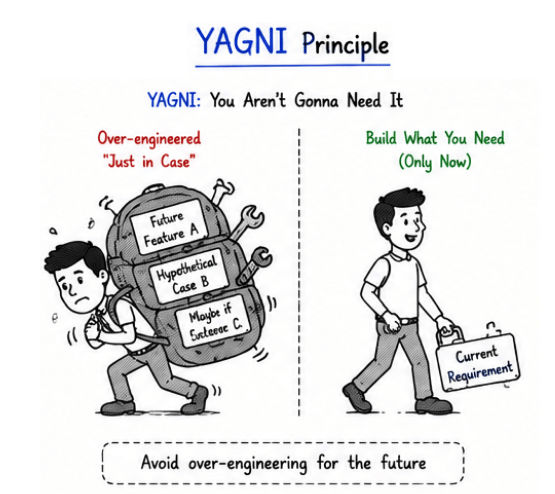
👉 YAGNI helps developers avoid overengineering and keeps applications focused and maintainable.
Variables, methods, classes, and packages should use clear and meaningful names that describe their purpose properly.
Good naming helps developers understand code without needing extra explanations.
Bad Examples
int d;
String str;
List<User> l;
Good Examples
int employeeAge;
String customerName;
List<User> activeUsers;
Good Practices
Use descriptive variable and method names
Follow standard Java naming conventions
Avoid unclear or unnecessary abbreviations
Choose names that clearly express purpose
Use verbs for method names and nouns for class names
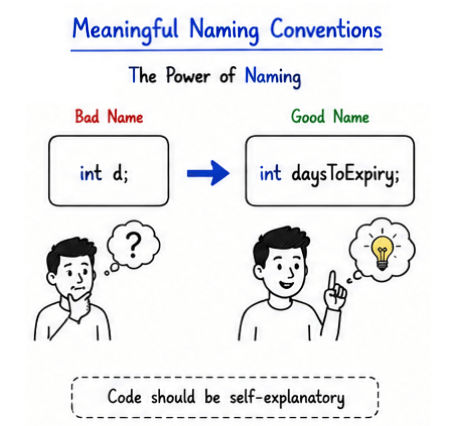
👉 Meaningful names make code more readable, maintainable, and self-explanatory.
Clean code should be written in a way that is easy to read, understand, and maintain by any developer.
Important Rules
Use proper indentation and consistent formatting
Avoid deeply nested conditions
Write modular and reusable code
Keep classes small and responsibility-focused
Use comments only when necessary
Follow consistent naming conventions
👉 Readable and maintainable code reduces confusion, improves collaboration, and makes future modifications easier.
Code smells are warning signs that indicate poor code structure or bad coding practices.
They may not immediately break the application, but they make code harder to maintain, understand, and extend.
A God Class is a large class that handles too many responsibilities at the same time.
Common Problems
Difficult to maintain
Hard to test
Creates high coupling
Violates the Single Responsibility Principle (SRP)
Example Scenario
One class handling:
User management
Database operations
Email sending
Payment processing
creates unnecessary complexity.
Better Approach
Split responsibilities into smaller, focused classes.
For example:
UserService → Handles user-related operations
EmailService → Manages email notifications
PaymentService → Processes payments
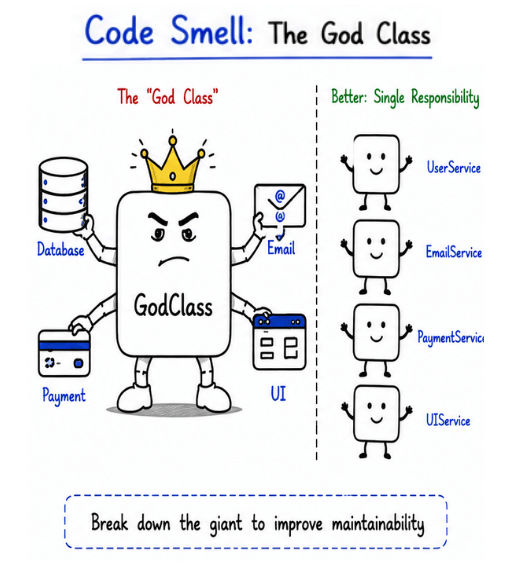
👉 Smaller classes improve modularity, readability, and maintainability.
Very large methods become difficult to read, debug, and maintain.
Common Problems
Complex logic
Poor readability
Difficult testing
Hard maintenance
Example Scenario
A single method performing:
Validation
Database operations
Logging
Notification sending
makes the code difficult to manage.
Better Approach
Break large methods into smaller, focused methods.
validateUser();
saveUser();
sendNotification();
👉 Small methods improve readability and simplify maintenance.
Duplicate logic occurs when the same code is repeated in multiple places.
Common Problems
Difficult maintenance
Increased bugs
Code inconsistency
Example Scenario
The same validation logic is written separately across multiple classes.
Better Approach
Extract common logic into reusable components, such as:
Utility classes
Shared services
Reusable methods
👉 Reducing duplication keeps applications cleaner and easier to maintain.
Clean code principles are heavily followed in modern software development to build scalable, maintainable, and professional applications.
They are widely used in:
Spring Boot applications
Enterprise backend systems
REST API development
Microservices architecture
Banking and financial applications
E-commerce platforms
Open-source software projects
Clean Code Principles help developers write professional, readable, maintainable, and scalable Java applications.
They help developers:
Improve overall code quality
Reduce unnecessary complexity
Build maintainable software systems
Improve collaboration within development teams
Create cleaner and more organized software architecture
Writing clean code is one of the most important skills for becoming a professional Java developer and software engineer.
