
Durgesh Tiwari
Author
MVC (Model-View-Controller) is a widely used architectural pattern that separates an application into different layers.. It helps developers organize code in a clean and structured way by separating business logic, user interface, and request handling.
In simple words: MVC divides an application into separate parts where each part performs a specific responsibility.
MVC stands for:
Model → Handles application data and business logic
View → Handles the user interface (UI)
Controller → Handles user requests and application flow
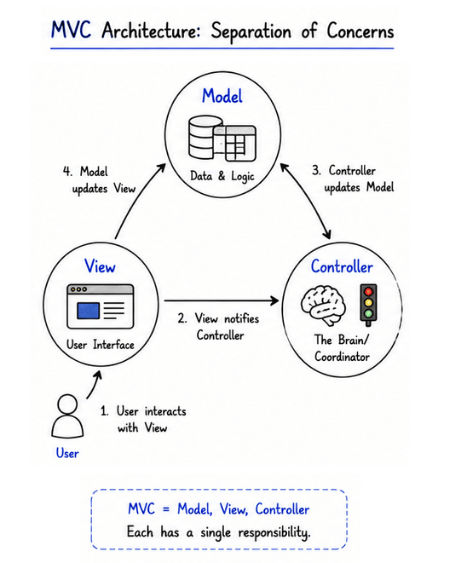
This separation helps applications become easier to manage, maintain, and scale.
MVC improves code organization by separating frontend, backend logic, and request handling into independent layers.
The Model represents application data and business logic. It is responsible for managing data and interacting with the database.
Responsibilities
Managing application data
Implementing business rules
Interacting with the persistence layer when required
Handling data validation
Example
In an e-commerce application:
Product
User
Order
classes act as Models because they store and manage application data.
👉 The Model focuses only on data and business processing, independent of the user interface.
The View is responsible for displaying information to users. It handles the presentation layer of the application.
Responsibilities
Displaying UI pages
Showing data received from the Model
Handling presentation logic
Example
In Java web applications:
HTML pages
JSP pages
Thymeleaf templates
act as Views because they display data to users.
👉 The View focuses only on presentation and user interaction.
The Controller acts as an intermediary between the Model and the View. It receives user requests, processes them, and returns responses.
Responsibilities
Receiving user requests
Calling business logic
Returning responses to the View
Managing application flow
Example
In Spring Boot:
@Controller
public class UserController {
}
handles incoming HTTP requests.
👉 The Controller connects frontend requests with backend processing and controls application flow.
MVC architecture follows a structured request-response flow where each layer performs a specific responsibility independently.
MVC Flow
User Request
      ↓
Controller
      ↓
Model
      ↓
Database / Business Logic
      ↓
Controller
      ↓
View
      ↓
Response to User
Flow Explanation
The user sends a request from the UI.
The Controller receives and processes the request.
The Controller calls the Model to execute business logic or fetch data.
The Model interacts with the database if needed.
The processed result is returned to the Controller.
The Controller sends data to the View.
The View displays the final response to the user.
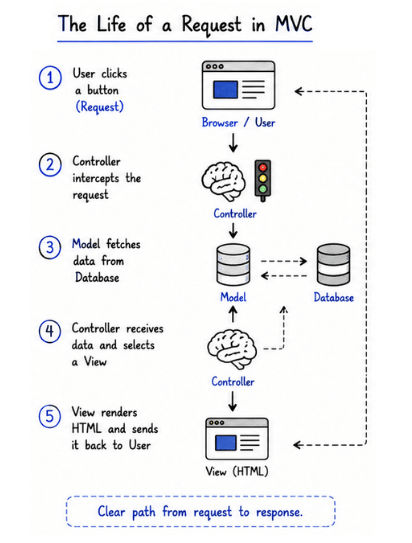
👉 Each MVC component works independently, which improves code organization and maintainability.
In large applications, mixing UI code, business logic, and database operations in the same place makes the system difficult to manage and maintain.
MVC solves this problem by separating responsibilities into independent layers.
Benefits of MVC Pattern
Improves code organization
Makes applications easier to maintain
Supports scalable application development
Separates business logic from UI
Simplifies debugging and testing
Improves collaboration between frontend and backend teams
👉 MVC helps developers build clean, modular, and maintainable applications.
MVC architecture is widely used in modern Java web development frameworks because it helps organize applications into separate layers for better maintainability and scalability.
Spring MVC
Spring Boot
Apache Struts
JavaServer Faces
Practical Usage
These frameworks use MVC architecture to separate:
Business logic
User interface
Request handling
which makes applications easier to develop, test, and maintain.
This example shows how the Model, View, and Controller work together in an MVC-based application.
The Model stores user data and represents application business data.
public class User {

    private String username;
    private String password;
}The Controller receives the login request and controls application flow.
@Controller
public class LoginController {

    @PostMapping("/login")
    public String login() {
        return "home";
    }
}The View displays the login form to the user.
<form action="/login" method="post">
    <input type="text" name="username" placeholder="Username">
    <input type="password" name="password" placeholder="Password">
    <button type="submit">Login</button>
</form>User enters login details in the View.
The request is sent to the Controller.
The Controller processes the request using Model data.
The response is returned to the View.
The View displays the result to the user.
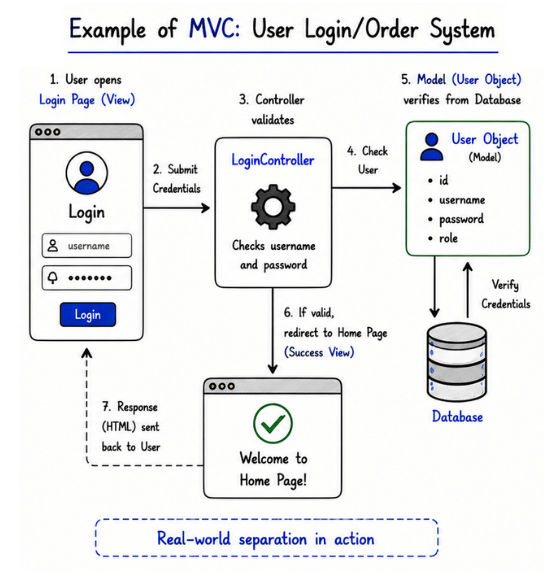
👉 The Controller handles requests, the Model manages data, and the View displays information.
Can feel complex for very small applications
Requires proper project structure and layer management
Increases the number of files and components
Beginners may initially find the architecture difficult to understand
Traditional Architecture | MVC Architecture |
|---|---|
UI, business logic, and database code are mixed together | Application is divided into separate layers |
Difficult to maintain and modify | Easier to maintain and extend |
Creates tight coupling between components | Promotes loose coupling |
Hard to scale for large applications | Better scalability and flexibility |
Testing and debugging become difficult | Easier testing and debugging |
MVC architecture is most suitable when applications require proper structure, scalability, and maintainability.
Use MVC when:
Building web applications
Developing scalable systems
Multiple developers are working on the project
Application contains complex business logic
Long-term maintainability is important
👉 MVC is ideal for professional Java and enterprise applications.
MVC may not be necessary for very small or simple applications.
Avoid MVC when:
The application is extremely small
Business logic is very simple
Additional architectural layers are unnecessary
👉 Small projects may not require full MVC architecture.
Spring Framework provides one of the most widely used implementations of MVC architecture for building Java web applications.
Spring MVC separates application layers clearly, making applications easier to develop, test, and maintain.
MVC Layer | Spring Component |
|---|---|
Model | Java Classes / Services |
View | JSP / Thymeleaf Templates |
Controller |
|
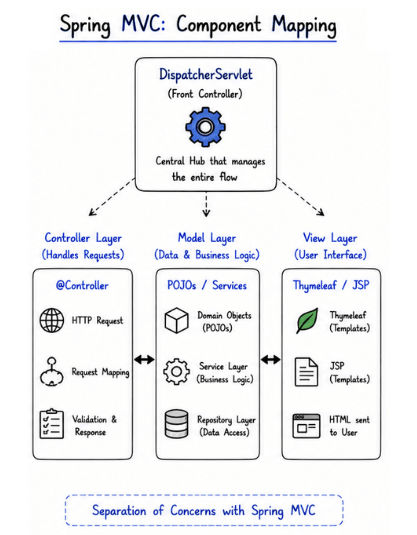
Spring MVC helps developers build clean, modular, and maintainable web applications using proper separation of concerns.
MVC (Model-View-Controller) is one of the most important architecture patterns used in Java application development.
It helps developers:
Separate application responsibilities clearly
Build scalable and maintainable systems
Improve code organization and structure
Simplify testing and debugging
Develop professional enterprise-level applications efficiently
👉 Understanding MVC architecture is essential for becoming a strong Java backend and Spring Boot developer.
