
Durgesh Tiwari
Author
In modern software development, applications are used by people from different countries, languages, and cultures. To support global users, developers use Internationalization (i18n) and Localization (l10n).
These concepts help applications support different regional and language-specific formats such as:
Currency
Date & Time
Number formatting
Language-specific content and messages
Internationalization and localization play an important role in building multilingual, user-friendly, and globally accessible applications.
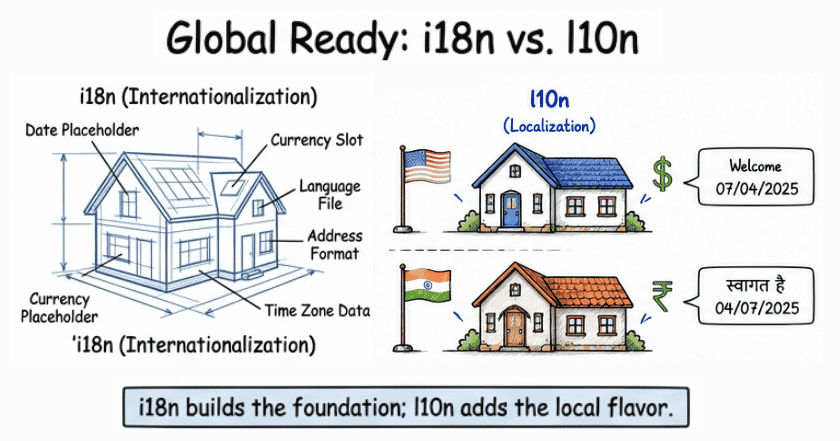
Internationalization (i18n) is the process of designing and developing an application in a way that it can easily support multiple languages, regions, and cultural formats without changing the core codebase.
In simple words, it means building software once and making it ready to be used globally.
The term i18n is derived from the word internationalization:
It starts with “i”
It ends with “n”
There are 18 letters between i and n
Internationalization acts as a foundation for localization (l10n) by making the application flexible, scalable, and language-independent.
The primary goal of i18n is to ensure that applications are:
Language-independent
Region-independent
Easily localizable for different markets
Simple to translate and maintain over time
Externalization of text and messages (no hardcoded strings)
Full Unicode support for global character sets
Locale-based formatting for dates, numbers, and currencies
Flexible and adaptable user interface design
Seamless support for multiple languages
Localization (l10n) is the process of adapting an application, product, or content to meet the language, cultural, and regional requirements of a specific audience or country.
In simple terms, localization makes an application feel like it was built specifically for local users.
The term l10n is a shortened form of localization:
It starts with “l”
It ends with “n”
There are 10 letters between l and n
Localization builds on top of internationalization (i18n) by customizing the application for different regions and user preferences.
The main goal of localization is to make the application feel natural and relevant for users in a specific location by focusing on:
Translating text into the local language
Formatting dates, times, numbers, and currencies according to regional standards
Adapting content to match cultural expectations
Delivering a region-specific user experience
Localization (l10n) can be clearly understood through real-world regional differences in how applications display content:
Region | Example |
|---|---|
USA | Date format → MM/DD/YYYY |
India | Currency → ₹ (INR - Indian Rupee) |
France | Language → French interface (Français) |
Japan | Language → Japanese text + Yen currency (¥) |
Internationalization (i18n) | Localization (l10n) |
|---|---|
Prepares an application to support multiple languages and regions | Adapts an application for a specific language, country, or culture |
Done during the development phase | Done after internationalization is implemented |
Focuses on building a flexible and scalable structure | Focuses on translation and regional customization |
Usually a one-time setup in the codebase | Repeated for each language or region |
Makes the app ready for global use | Makes the app feel local to users |
Modern businesses operate globally, with users from different countries, languages, and cultures. That’s why multilingual applications are important for making digital products more accessible and user-friendly.
A multilingual application lets users use the same platform in their preferred language, creating a smoother and more comfortable experience.
This approach helps improve:
User experience, by making the application easy to understand
Customer engagement, by connecting better with local users
Global accessibility, so people from different regions can use the product
Business growth, by reaching a larger audience
International market reach, by supporting multiple languages and regions
Better global communication with users from different regions
Improved customer satisfaction through language-friendly experiences
Increased accessibility, making the product usable for more people
Stronger international branding and market presence
More business opportunities across different countries and regions
Many popular applications and websites use localization to improve user experience for different regions and languages.
E-Commerce Websites: Amazon shows local currency, regional languages, and country-specific offers.
Streaming Platforms: Netflix and YouTube provide subtitles, multi-language audio, and localized recommendations.
Social Media Applications: Facebook and Instagram support multiple languages and regional content.
Banking Applications: Banking apps adjust currency, date formats, and language settings based on region.
Travel Applications: Google Maps supports local languages and region-specific travel information.
Food Delivery Applications: Zomato and Uber Eats show local restaurants and regional payment methods.
Online Payment Systems: PayPal and PhonePe support localized payment and currency conversion features.
Developing global applications introduces many technical and cultural challenges.
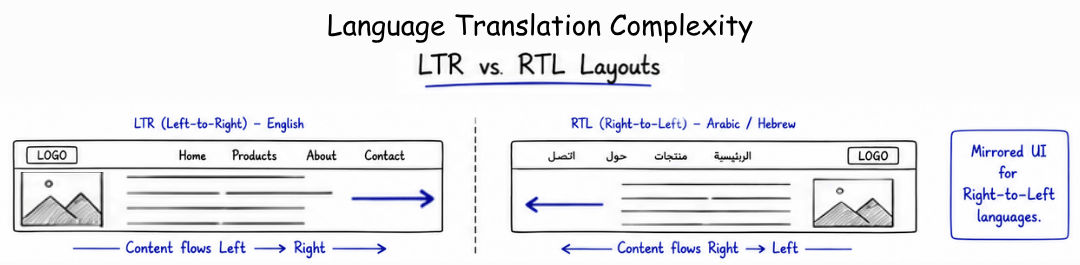
Different languages have different grammar rules, sentence structures, and writing styles, which makes accurate translation difficult.
Example: English sentence structure is different from Japanese or Arabic, so direct translation may sound incorrect.
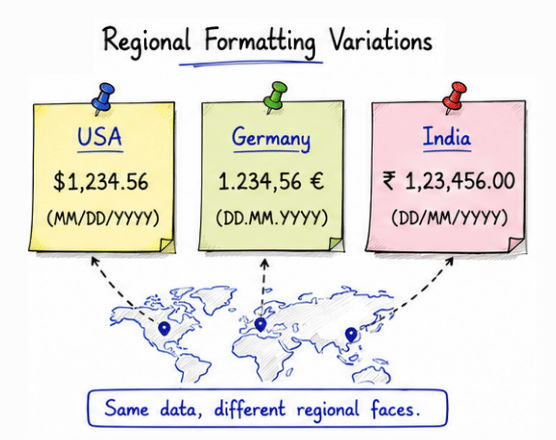
Different countries use different date and time formats.
Example:
USA → MM/DD/YYYY
India → DD/MM/YYYY
Regions use different currency symbols, decimal separators, and number formats.
Example:
USA → $1,000.50
Germany → €1.000,50
Applications must support special characters and multiple languages from different writing systems.
Example: Applications should correctly display Hindi, Chinese, Japanese, and Arabic characters.
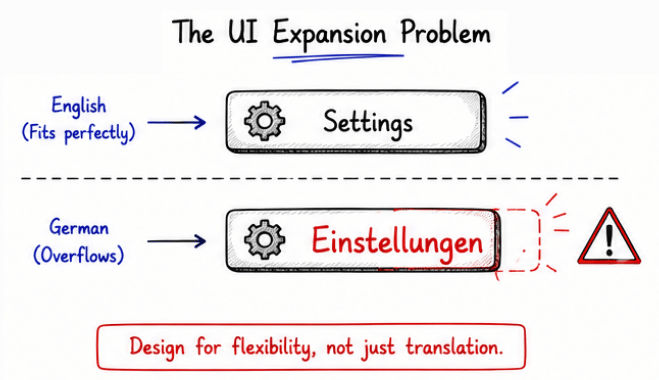
Some languages require more screen space, which can affect the application’s user interface design.
Example: German words are usually longer than English words and may break button or menu layouts.
Colors, symbols, images, and content may have different meanings in different cultures.
Example: White color represents peace in some countries but may represent mourning in others.
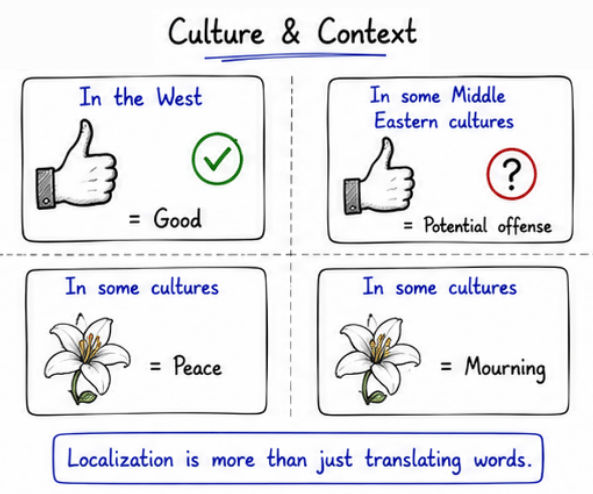
Global applications must correctly handle different time zones for users across countries.
Example: A meeting scheduled for 10 AM in India will show a different time for users in the USA or UK.
Managing translations and regional updates for multiple languages can become complex in large applications.
Example: Updating application content in 20 different languages requires continuous translation and maintenance work.
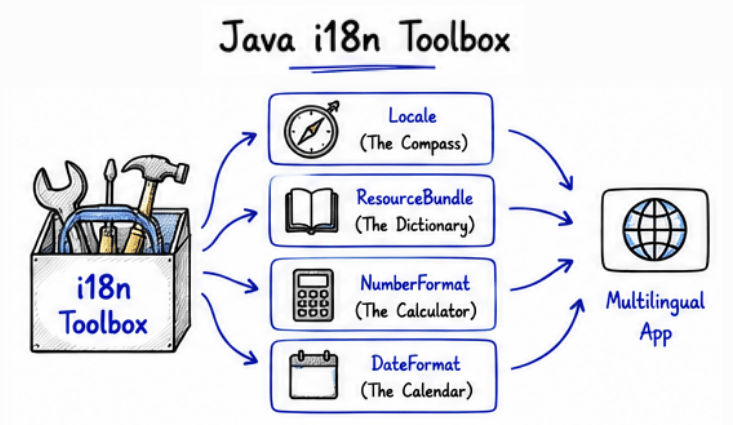
Java provides several built-in classes for internationalization and localization.
Locale → Represents a specific language and region.
ResourceBundle → Stores language-specific text and messages.
NumberFormat → Formats numbers and currencies according to locale.
DateFormat → Formats date and time based on regional settings.
MessageFormat → Creates dynamic and localized messages.
These classes help developers build multilingual and region-specific Java applications efficiently.
Better user experience for global users
Easier support for multiple languages
Improved software accessibility
Faster expansion into international markets
Easier maintenance and updates
Better customer engagement and satisfaction
Increased global business reach
Internationalization (i18n) and Localization (l10n) are important concepts in modern software development. They help applications support multiple languages, regions, and cultural preferences.
By implementing proper i18n and l10n techniques, developers can build:
User-friendly applications
Globally accessible systems
Better multilingual experiences
These concepts are essential for creating scalable and modern global applications in Java and other technologies.
