
Durgesh Tiwari
Author
SOLID Principles are five important object-oriented design principles used to create clean, maintainable, scalable, and flexible software applications.
These principles help developers design better software by reducing complexity and improving application architecture.
In simple words: SOLID principles are guidelines for writing clean and professional object-oriented code.
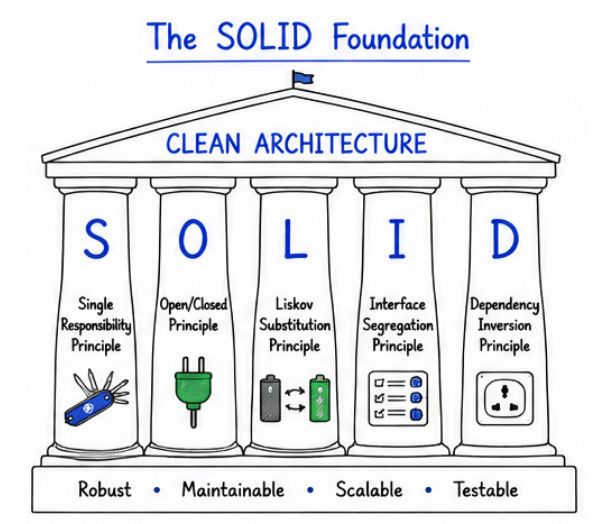
SOLID is an acronym representing five software design principles introduced by Robert C. Martin.
The five principles are:
S → Single Responsibility Principle (SRP)
O → Open/Closed Principle (OCP)
L → Liskov Substitution Principle (LSP)
I → Interface Segregation Principle (ISP)
D → Dependency Inversion Principle (DIP)
👉 These principles form the foundation of clean architecture and enterprise-level software design.
As applications grow larger, poorly designed code becomes difficult to manage, test, and extend. SOLID principles help developers build software that remains organized and easy to maintain even as complexity increases.
Benefits of SOLID Principles
Improve code maintainability
Reduce tight coupling between classes
Increase flexibility and scalability
Make applications easier to test
Improve readability and reusability
Simplify future modifications and feature additions
The Single Responsibility Principle states that a class should have only one reason to change.
👉 A class should handle only one specific responsibility or functionality.
Problem Without SRP
If a single class handles:
Business logic
Database operations
Email notifications
then the class becomes difficult to maintain, test, and modify.
Better Approach Using SRP
Responsibilities should be divided into separate classes:
UserService → handles user-related business logic
UserRepository → manages database operations
EmailService → handles email sending functionality
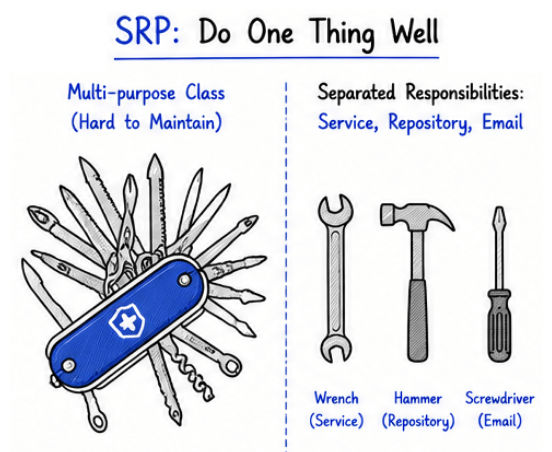
In a Spring Boot application, different layers and services are separated based on their responsibilities to keep the code clean and maintainable.
👉 SRP improves maintainability, testing, readability, and scalability of applications.
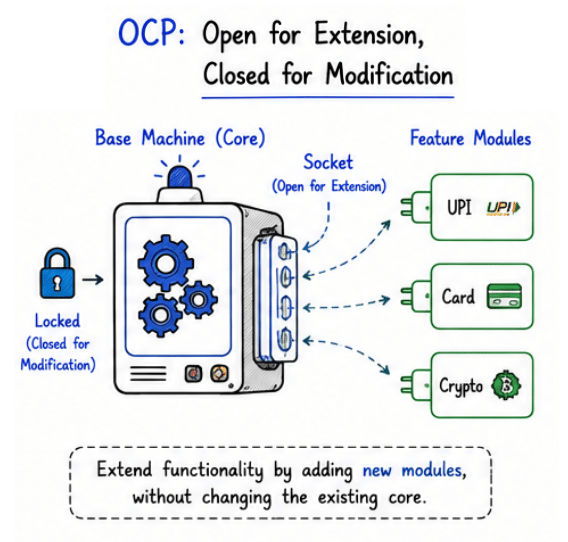
The Open/Closed Principle states that software entities should be open for extension but closed for modification.
👉 Existing code should support new functionality without changing already tested and stable code.
Real-World Scenario
Consider a payment processing system in an e-commerce application.
Instead of modifying the same payment class whenever a new payment method is introduced, different payment types can implement a common Payment interface.
Examples:
CreditCardPayment
UPIPayment
PayPalPayment
This allows developers to add new payment methods without modifying existing implementation logic.
👉 OCP helps applications grow without affecting previously working code.
Makes feature expansion easier
Reduces risk of breaking existing functionality
Improves maintainability and scalability
Encourages cleaner architecture and reusable code
The Liskov Substitution Principle states that child classes should be replaceable with parent classes without changing the expected behavior of the application.
👉 A subclass should correctly follow the behavior defined by its parent class.
Problem Without LSP
Consider a Bird class with a fly() method.
Sparrow can fly
Penguin cannot fly
If Penguin inherits the same behavior, the design becomes incorrect because it cannot properly support the fly() functionality.
Better Design Approach
Instead of forcing all birds to fly, behavior should be separated properly.
Example:
FlyingBird → supports flying behavior
NonFlyingBird → represents birds that cannot fly
This keeps class behavior accurate and avoids unexpected runtime problems.
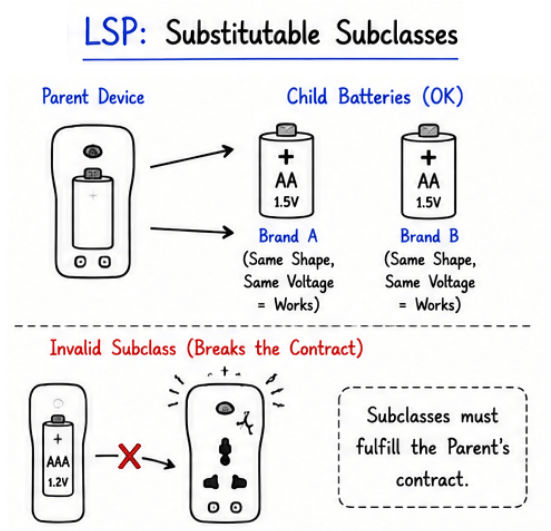
In enterprise applications, subclasses should always preserve the expected behavior of their parent classes so components remain reliable and interchangeable.
👉 Violating LSP can lead to unstable code, unexpected behavior, and difficult-to-maintain systems.
The Interface Segregation Principle states that classes should not be forced to implement methods they do not actually need.
👉 Instead of creating one large interface, it is better to create smaller and more specific interfaces.
Problem Without ISP
Consider a Worker interface containing:
work()
eat()
This design creates problems because not every worker needs both behaviors.
For example:
Human workers can work and eat
Robot workers can work but do not eat
Forcing robots to implement eat() creates unnecessary and incorrect design.
Better Design Approach
The interface can be divided into smaller interfaces such as:
Workable
Eatable
This allows classes to implement only the functionality they actually require.
In backend applications, separate interfaces are commonly created for different responsibilities:
PaymentService
NotificationService
ReportService
instead of using one large interface containing unrelated methods.
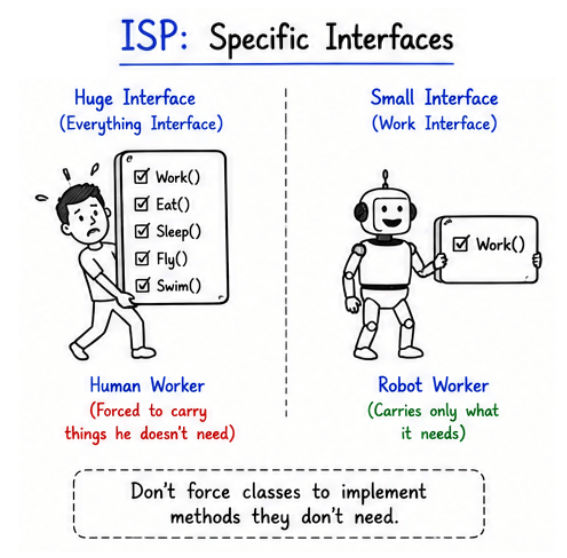
👉 ISP helps create cleaner, flexible, and easier-to-maintain software architecture.
The Dependency Inversion Principle states that high-level modules should not depend directly on low-level modules. Both should depend on abstractions.
In simple words: Classes should depend on interfaces rather than concrete implementations.
Problem Without DIP
Consider an OrderService directly creating a database object:
MySQLDatabase db = new MySQLDatabase();
This creates tight coupling because the service becomes dependent on a specific database implementation.
If the database changes from MySQL to PostgreSQL, the existing code must also be modified.
Better Design Approach
Instead of depending on a concrete class, the service should depend on an abstraction:
Database db;
Now different database implementations can be used without changing the service logic.
Frameworks like Spring Framework heavily use Dependency Injection to implement DIP.
For example:
Service layer depends on a Repository interface
Spring automatically injects the required implementation at runtime
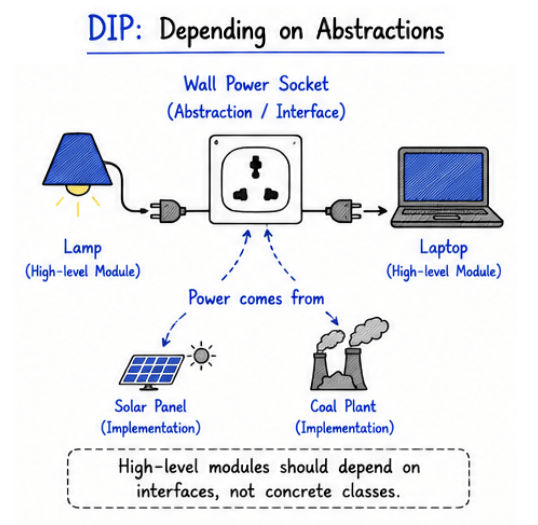
👉 DIP reduces tight coupling, improves flexibility, and makes applications easier to test and maintain.
Principle | Main Idea |
|---|---|
SRP (Single Responsibility Principle) | A class should handle only one responsibility |
OCP (Open/Closed Principle) | Existing code should support extension without modification |
LSP (Liskov Substitution Principle) | Child classes should properly behave as parent classes |
ISP (Interface Segregation Principle) | Interfaces should be small and specific |
DIP (Dependency Inversion Principle) | Depend on abstractions instead of concrete implementations |
SOLID principles are widely used in:
Spring Framework
Spring Boot applications
Enterprise backend systems
REST APIs
Microservices architecture
Banking and e-commerce systems
👉 Most modern enterprise applications follow SOLID principles internally.
SOLID principles are the foundation of Clean Architecture.
They help developers build applications that are:
Modular
Testable
Scalable
Flexible
Easy to maintain
👉 Clean Architecture heavily depends on SOLID-based design.
Use SOLID principles when:
Building large applications
Designing scalable systems
Working in enterprise projects
Creating reusable components
Building long-term maintainable software
👉 SOLID is especially important in backend and enterprise Java development.
Although SOLID principles are powerful, overengineering small applications can create unnecessary complexity.
Avoid excessive abstraction when:
The project is very small
Simpler code is sufficient
Extra layers reduce readability
👉 Use SOLID principles practically, not blindly.
SOLID Principles are the core foundation of clean and professional object-oriented software design in Java.
They help developers:
Write clean and maintainable code
Build scalable enterprise applications
Reduce tight coupling
Improve flexibility and testing
