
Durgesh Tiwari
Author
DAO (Data Access Object) Pattern is a design pattern used to separate database operations from business logic in an application. It provides a dedicated layer responsible for accessing and managing database data.
In simple words: DAO pattern separates database-related code from the main application logic.
The DAO Pattern creates separate classes that handle database operations such as:
Inserting data
Updating data
Deleting data
Fetching data
Instead of writing SQL queries directly inside service or business classes, DAO classes manage all database interactions.
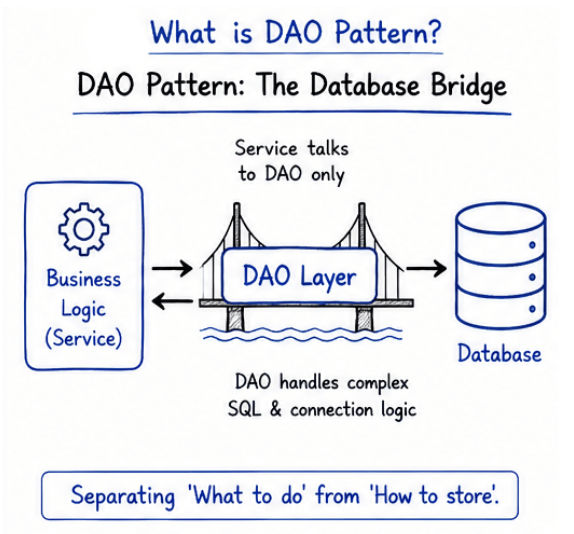
👉 This separation improves application structure and maintainability.
In large applications, combining database logic with business logic makes code difficult to maintain, test, and scale.
DAO pattern solves this problem by separating responsibilities into different layers.
Benefits of DAO Pattern
Separates database logic from business logic
Improves code maintainability
Makes applications easier to scale
Simplifies database management
Improves testing and debugging
Supports cleaner application architecture
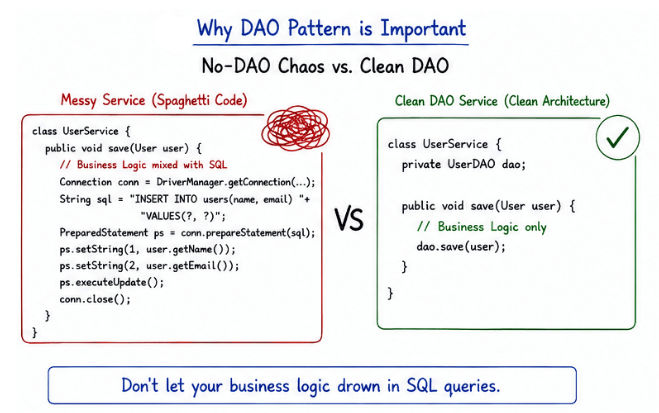
👉 DAO pattern is widely used in enterprise Java applications and backend systems.
DAO architecture usually contains the following components:
Component | Responsibility |
|---|---|
Model / Entity | Represents application data and database tables |
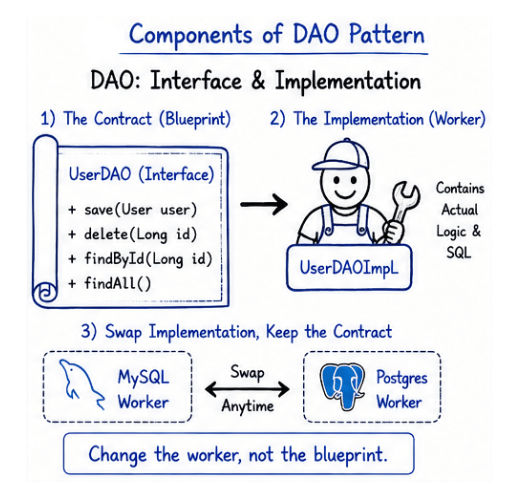
DAO Interface | Defines database operation methods |
DAO Implementation | Contains actual database queries and logic |
Service Layer | Handles business logic and application processing |
Database | Stores and manages application data |
Client
   ↓
Service Layer
   ↓
DAO Layer
   ↓
Database
Explanation
The Client sends a request to the application.
The Service Layer handles business logic and validation.
The DAO Layer performs database operations.
The Database stores or retrieves data.
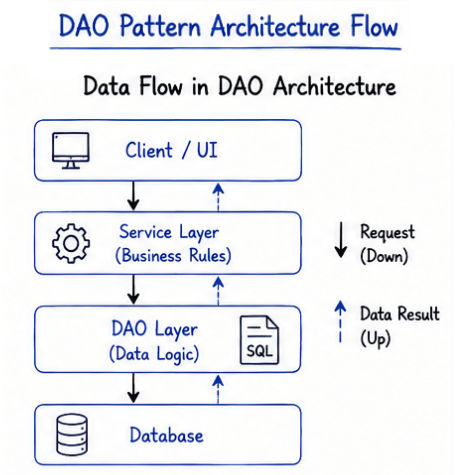
👉 DAO acts as a bridge between the application and the database, helping keep database logic separate from business logic.
This example shows how different layers work together in the DAO architecture.
The Model class represents application data.
public class User {

    private int id;
    private String name;

    // getters and setters
}
👉 This class stores user-related data.
The DAO interface defines database operation methods.
public interface UserDAO {

    void save(User user);

    User findById(int id);
}
👉 The interface defines what operations can be performed on the database.
The DAO implementation class contains the actual database logic.
public class UserDAOImpl implements UserDAO {

    @Override
    public void save(User user) {
        System.out.println("User saved to database");
    }

    @Override
    public User findById(int id) {
        return new User();
    }
}
👉 This layer handles database-related operations.
The Service Layer contains business logic and communicates with the DAO layer.
public class UserService {

    private UserDAO userDAO = new UserDAOImpl();

    public void registerUser(User user) {
        userDAO.save(user);
    }
}
👉 Business logic communicates with the DAO layer instead of directly accessing the database.
Spring Framework and Spring Boot provide powerful support for implementing the DAO pattern in Java applications.
In modern Spring applications, DAO functionality is commonly implemented using:
Spring Data JPA
Hibernate
Repository interfaces
Example
@Repository
public interface UserRepository
        extends JpaRepository<User, Integer> {
}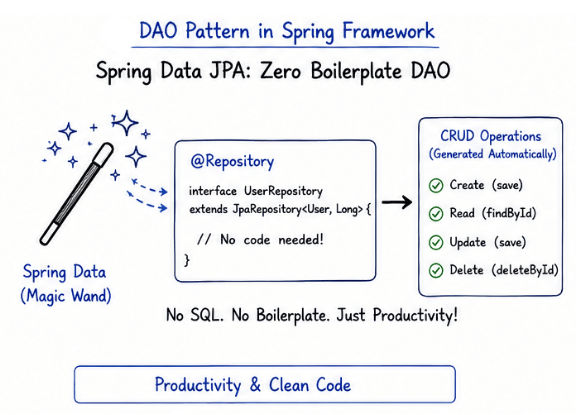
Spring automatically generates database operations internally
Reduces boilerplate database code
Simplifies CRUD operations
Improves development speed and maintainability
👉 Spring-based applications use Repository and DAO concepts to manage database communication cleanly and efficiently.
Increases the number of classes and layers
Can feel unnecessary for very small applications
Requires proper project structure and architecture planning
Adds slight complexity to simple projects
Traditional Database Access | DAO Pattern |
|---|---|
Database code is mixed with business logic | Database operations are handled in a separate DAO layer |
Difficult to maintain and modify | Easier to maintain and manage |
Creates tight coupling between components | Promotes loose coupling |
Testing becomes more difficult | Easier unit testing and debugging |
Code reuse is limited | Database logic becomes more reusable |
DAO Pattern | Repository Pattern |
|---|---|
Mainly focuses on database operations | Focuses on managing domain objects and business data |
Lower-level abstraction | Higher-level abstraction |
Commonly used with JDBC and Hibernate | Commonly used in Spring Data JPA |
Requires more manual query handling | Provides simplified data access methods |
Closely related to database tables | Works more with domain-driven design concepts |
👉 Repository pattern is considered an advanced form of DAO in modern Spring applications.
DAO pattern is useful when applications require proper separation between business logic and database operations.
Use DAO Pattern When
Working heavily with databases
Building enterprise-level applications
Developing scalable backend systems
Multiple modules interact with the database
Clean and maintainable architecture is required
Database operations need to be reusable and organized
DAO pattern may not be necessary for very small or simple applications.
Avoid DAO pattern when:
The application is extremely small
Only very simple CRUD operations are required
Additional architectural layers add unnecessary complexity
Database logic is minimal and easy to manage directly
DAO (Data Access Object) Pattern is an important architectural pattern used to separate database access logic from business logic in Java applications.
It helps developers:
Build clean and maintainable applications
Improve scalability and flexibility
Simplify database management
Create structured backend systems
Reduce tight coupling between layers
