
Durgesh Tiwari
Author
Structural Design Patterns in Java focus on organizing classes and objects to form larger and flexible structures. These patterns help simplify relationships between components and improve overall application design.
In simple words: Structural patterns help connect classes and objects in a clean, organized, and scalable way.
Structural design patterns define how classes and objects are combined to build larger systems while keeping the code flexible, reusable, and maintainable.
These patterns mainly focus on:
Class relationships
Object composition
Simplifying complex structures
Improving flexibility between components
👉 They help developers design clean and scalable software architecture.
As applications become larger and more complex, managing relationships between classes and objects becomes difficult. Structural patterns simplify this complexity and improve system organization.
Benefits
Improve code organization and structure
Increase application flexibility
Reduce tight coupling between classes
Improve code reusability
Simplify complex system design
Make applications easier to maintain and extend
👉 Structural patterns are widely used in enterprise applications to build modular and maintainable systems.
Structural design patterns help organize classes and objects to build flexible and maintainable software systems.
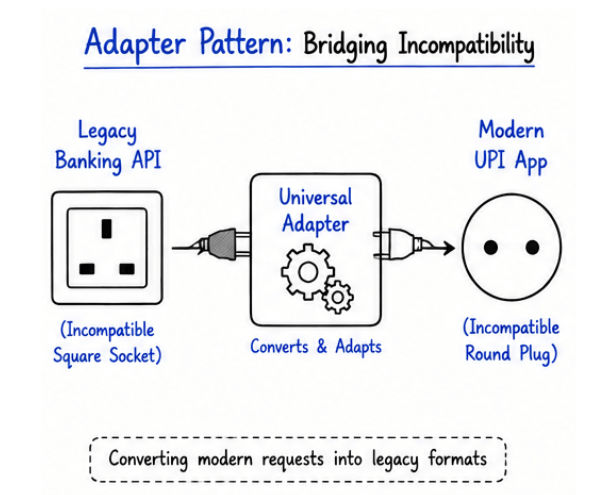
The Adapter Pattern allows incompatible classes to work together by converting one interface into another.
👉 Real-world use case: Connecting old legacy systems with modern applications.
Example:
A payment application needs to integrate with an old banking system that uses a different API format.
interface Charger {
    void charge();
}

class OldCharger {
    void oldCharge() {
        System.out.println("Charging using old charger.");
    }
}

class ChargerAdapter implements Charger {

    private OldCharger oldCharger;

    ChargerAdapter(OldCharger oldCharger) {
        this.oldCharger = oldCharger;
    }

    public void charge() {
        oldCharger.oldCharge();
    }
}
The Decorator Pattern adds new functionality to objects dynamically without modifying existing code.
👉 Real-world use case: Adding extra features to UI components or Java IO streams.
Example:
Adding milk or chocolate toppings to a coffee order.
interface Coffee {
    String prepare();
}

class SimpleCoffee implements Coffee {

    public String prepare() {
        return "Coffee";
    }
}

class MilkDecorator implements Coffee {

    private Coffee coffee;

    MilkDecorator(Coffee coffee) {
        this.coffee = coffee;
    }

    public String prepare() {
        return coffee.prepare() + " + Milk";
    }
}
The Proxy Pattern provides a placeholder or controlled access to another object.
👉 Real-world use case: Security checks, lazy loading, caching, remote service access.
Example:
Checking authentication before accessing bank account information.
interface Account {
    void access();
}

class RealAccount implements Account {

    public void access() {
        System.out.println("Access Granted");
    }
}

class AccountProxy implements Account {

    public void access() {
        System.out.println("Verifying User...");
        new RealAccount().access();
    }
}
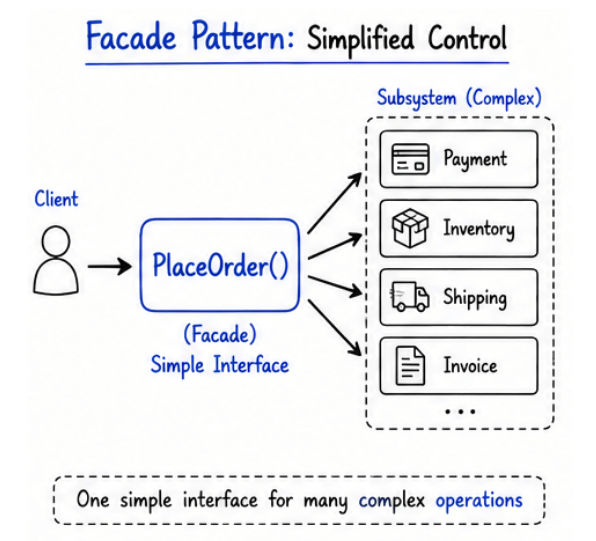
The Facade Pattern provides a simplified interface to a complex subsystem.
👉 Real-world use case: Simplifying interactions with large APIs or frameworks.
Example:
A single checkout service coordinating payment, inventory, and shipping systems.
class PaymentService {
    void pay() {
        System.out.println("Payment Completed");
    }
}

class ShippingService {
    void ship() {
        System.out.println("Order Shipped");
    }
}

class OrderFacade {

    void placeOrder() {

        new PaymentService().pay();

        new ShippingService().ship();
    }
}
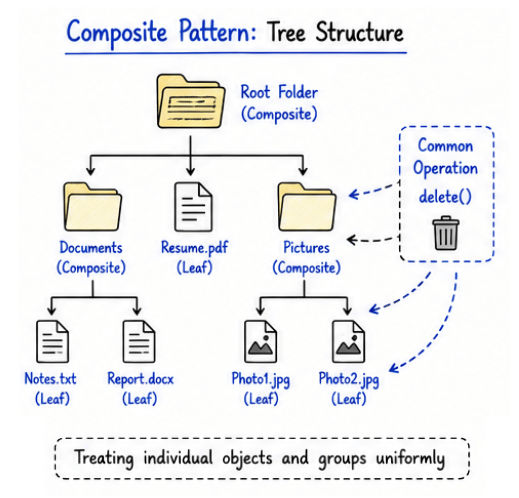
The Composite Pattern allows individual objects and groups of objects to be treated uniformly.
👉 Real-world use case: File systems, menu structures, organizational hierarchies.
Example:
Files and folders in a file explorer.
interface FileSystem {
    void show();
}

class File implements FileSystem {

    public void show() {
        System.out.println("File");
    }
}

class Folder implements FileSystem {

    public void show() {
        System.out.println("Folder");
    }
}
The Bridge Pattern separates abstraction from implementation so both can change independently.
👉 Real-world use case: Cross-platform applications and device-driver systems.
Example:
A remote control working with different TV brands.
interface TV {
    void on();
}

class SonyTV implements TV {

    public void on() {
        System.out.println("Sony TV On");
    }
}

class Remote {

    private TV tv;

    Remote(TV tv) {
        this.tv = tv;
    }

    void powerOn() {
        tv.on();
    }
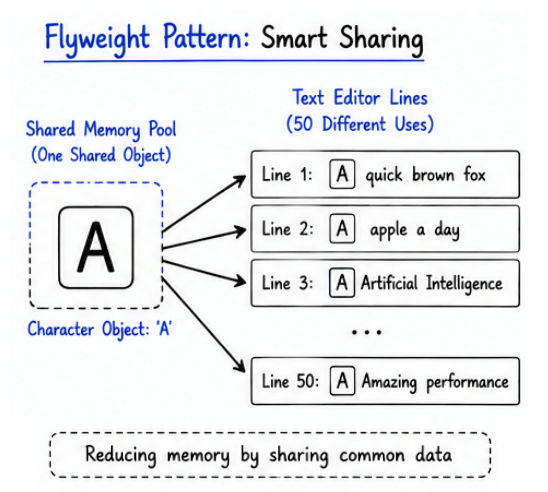
}The Flyweight Pattern reduces memory usage by sharing common objects instead of creating new objects repeatedly.
👉 Real-world use case: Game development, text editors, caching systems.
Example:
Text editors reusing character objects instead of creating duplicates.
class Character {

    private String value;

    Character(String value) {
        this.value = value;
    }

    void display() {
        System.out.println(value);
    }
}
Structural patterns are widely used in modern Java and enterprise applications.
Common Examples:
Spring Framework uses Proxy and Adapter patterns
Java IO classes use Decorator pattern
Hibernate internally uses Facade and Proxy patterns
UI frameworks use Composite pattern
API integration systems use Adapter and Facade patterns
Microservices architecture uses Facade and Proxy patterns
👉 These patterns help enterprise systems remain scalable, reusable, and maintainable.
Use structural patterns when:
Multiple classes need to work together
System structure becomes complex
You want flexible and reusable architecture
You need better separation between components
Existing classes need integration without modifying source code
👉 Avoid adding unnecessary structural patterns in very small or simple applications because they may increase complexity.
Structural Design Patterns help organize classes and objects efficiently in Java applications.
They help developers:
Build flexible and scalable system architecture
Improve code maintainability and reusability
Reduce dependency between components
Simplify complex software structures
Create clean enterprise-level applications
Structural patterns are important for designing maintainable, scalable, and professional software systems.
