
Durgesh Tiwari
Author
Continuous Integration (CI) is a software development practice where developers frequently merge their code changes into a shared repository. Each change is automatically built and tested to detect issues early in development.
In simple words: Continuous Integration automatically checks whether newly added code works correctly with the existing application.
Continuous Integration (CI) is the process of frequently integrating code changes into a shared project repository.
It mainly involves:
Regularly merging code changes.
Automatically building the application.
Running automated tests after every change.
This helps developers detect bugs and integration issues early in the development process.
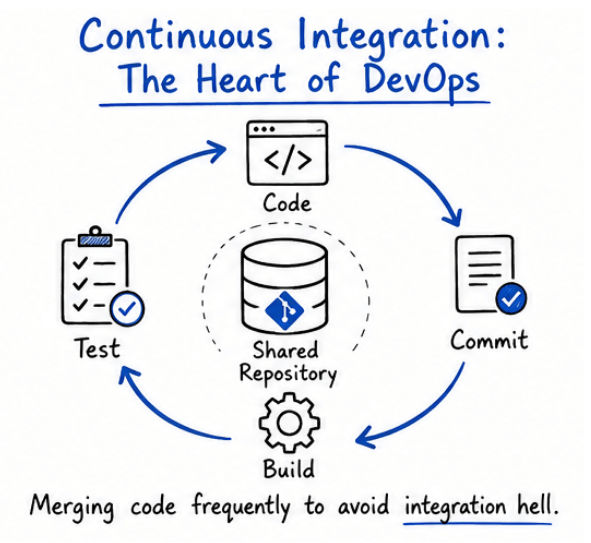
👉 Continuous Integration is an important practice in modern DevOps and Agile software development.
Typical CI workflow:
Developer Writes Code
          ↓
Pushes Code to Repository
          ↓
CI Server Detects Changes
          ↓
Project Build Starts
          ↓
Automated Tests Run
          ↓
Build Status Generated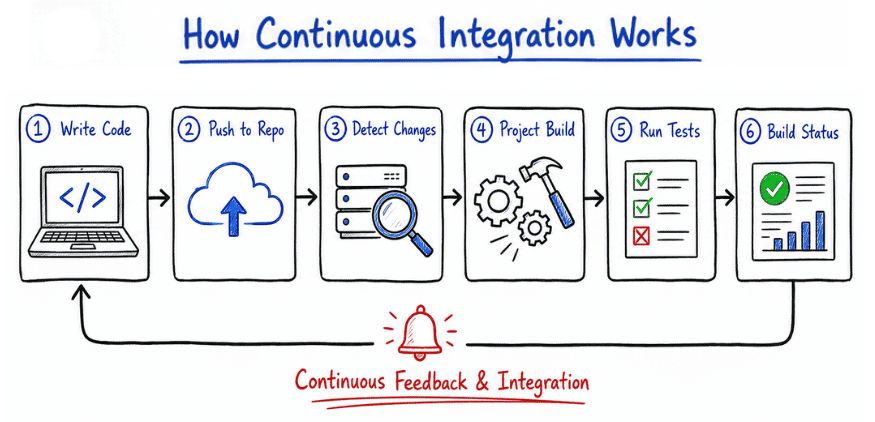
👉 If tests fail, developers are notified immediately.
Continuous Integration is implemented using different automation tools that help in building, testing, and deploying applications efficiently.
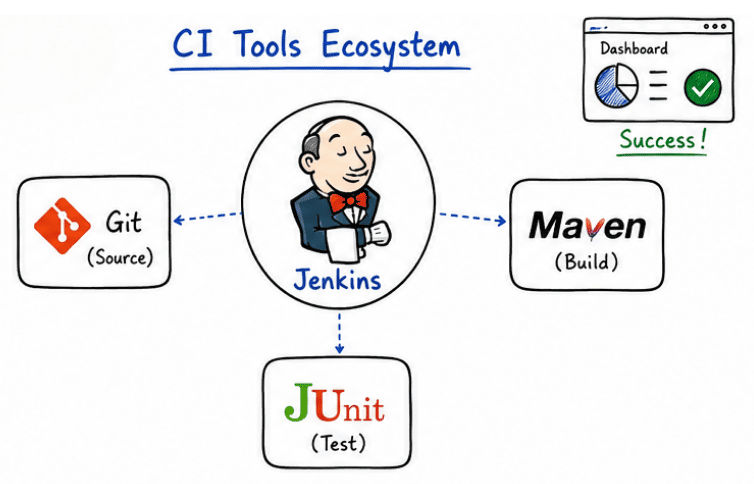
Jenkins is one of the most popular open-source CI tools used in Java and enterprise development.
Features:
Automates build and deployment processes
Supports pipelines for CI/CD workflows
Provides a large plugin ecosystem
Integrates with Git, Maven, and Gradle
Jenkinsfile Example
pipeline {

    agent any

    stages {

        stage('Build') {
            steps {
                sh 'mvn clean compile'
            }
        }

        stage('Test') {
            steps {
                sh 'mvn test'
            }
        }

        stage('Package') {
            steps {
                sh 'mvn package'
            }
        }
    }
}GitHub Actions is a CI/CD tool integrated directly with GitHub repositories.
Automates workflows like build, test, and deploy
Triggered by code push or pull requests
Easy configuration using YAML files
GitLab CI/CD is a built-in automation tool provided by GitLab.
Direct integration with GitLab repositories
Supports pipelines and stages
Easy setup with .gitlab-ci.yml file
These are cloud-based CI platforms used for automation.
CircleCI: Fast builds and cloud-based pipelines
Travis CI: Simple CI setup for open-source projects
👉 These tools help automate the software development lifecycle and improve delivery speed and reliability.
A CI pipeline is a series of automated steps that run whenever code is pushed to a repository. It ensures that the application is continuously built, tested, and validated before deployment.
Stage | Purpose |
|---|---|
Build | Compiles the source code and checks for errors |
Test | Runs automated unit and integration tests |
Analyze | Performs code quality checks and static analysis |
Package | Creates deployable files like JAR or WAR |
Deploy | Deploys the application to a server or environment |

👉 CI pipelines help automate the software delivery process, reduce manual work, and ensure consistent application quality.
mvn clean testThis command is commonly used in Continuous Integration pipelines to validate the code.
It performs the following steps:
Cleans previous build files (target/ folder)
Compiles the source code
Runs all unit tests automatically
👉 If any test fails, the CI pipeline also fails, helping developers catch issues early.
Continuous Integration (CI) is widely used in modern Java development to automatically build, test, and validate applications whenever code changes are pushed.
It is commonly applied in:
Spring Boot applications
REST API development
Enterprise backend systems
Microservices architecture
Android applications
Build tools like Maven and Gradle are frequently integrated with CI systems to automate:
Code compilation
Testing
Packaging
Deployment preparation
Faster detection of bugs and issues
Improved software quality and stability
Automated builds and testing reduce manual effort
Better collaboration between team members
Faster and more frequent software releases
Continuous Integration (CI) is very useful, but it also comes with some limitations that developers should be aware of.
Initial setup can take time and effort, especially for complex projects.
Requires proper automated test cases to get full benefit.
Poorly configured pipelines can slow down the build and deployment process.
Maintenance of CI tools and pipelines adds extra responsibility.
Requires team discipline to follow proper commit and integration practices.
Continuous Integration (CI) is heavily used in:
Enterprise applications where multiple teams work on large systems
Banking systems that require high reliability and continuous testing
E-commerce platforms with frequent updates and new features
Cloud-native applications that run on distributed environments
DevOps environments for automated build, test, and deployment pipelines
👉 CI is essential in all modern large-scale software systems to maintain speed, stability, and quality.
Continuous Integration (CI) is an essential software development practice that automates code integration, building, and testing processes.
It helps in:
Early detection of bugs and errors.
Improving overall software quality.
Supporting automated build and testing workflows.
Making development faster and more reliable.
Being an essential part of modern Java and DevOps practices.
👉 CI helps development teams build stable, reliable, and production-ready applications efficiently.
