
Durgesh Tiwari
Author
Unit testing is a software testing technique where individual components or methods of a program are tested in isolation to ensure they work correctly.
In simple words: Unit testing means testing small parts of code (like a single method) to verify they are working properly.
Unit testing focuses on testing the smallest unit of an application, such as:
Methods
Classes
Functions
It is done to verify that each unit of code works as expected and produces correct output for given inputs.
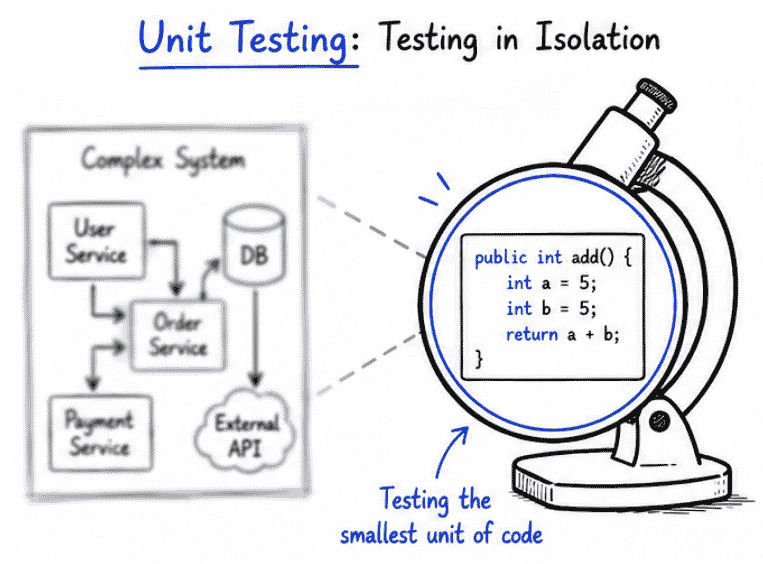
👉 Unit testing is mostly done by developers during the development phase.
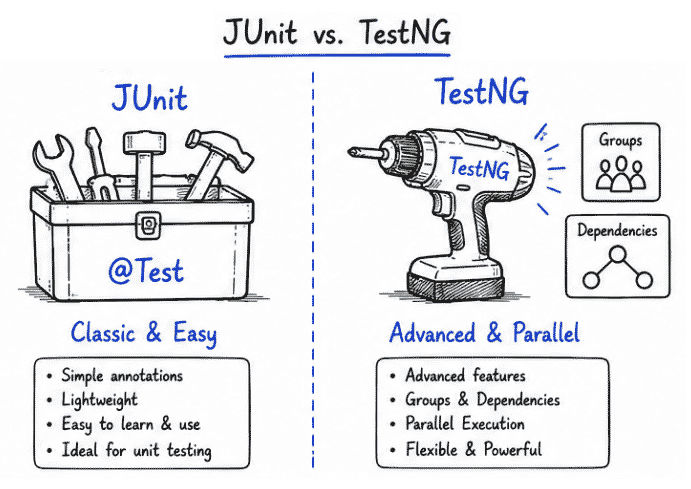
JUnit provides tools for writing and running unit tests in Java applications.
TestNG is an advanced testing framework used for more flexible and powerful testing needs.
Most widely used Java testing framework
Simple and easy to learn
Uses annotations like @Test
Commonly used in enterprise Java projects
Example of Unit Testing (Java)
public class Calculator {

    public int add(int a, int b) {
        return a + b;
    }
}TestNG is an advanced testing framework used for more flexible and powerful testing needs.
Supports parallel test execution
More flexible configuration than JUnit
Useful for large-scale testing projects
Supports grouping and dependency-based tests
Test Case Example (JUnit)
import static org.junit.Assert.assertEquals;
import org.junit.Test;

public class CalculatorTest {

    @Test
    public void testAdd() {
        Calculator calc = new Calculator();
        assertEquals(10, calc.add(5, 5));
    }
}
👉 This test checks whether the add() method is returning the correct result.
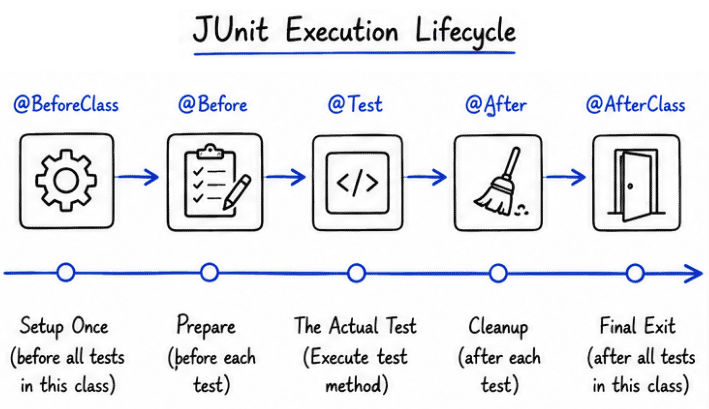
Annotation | Purpose |
|---|---|
| Marks a method as a test case |
| Runs before each test method |
| Runs after each test method |
| Runs once before all test methods |
| Runs once after all test methods |
public class Calculator {

public int add(int a, int b) {
return a + b;
}
}
👉 This is a simple Java class with an add() method that will be used for unit testing.
JUnit and TestNG are used to execute unit tests and verify code correctness.
Write a method (actual business logic)
Create a test case for that method
Run the test using JUnit/TestNG
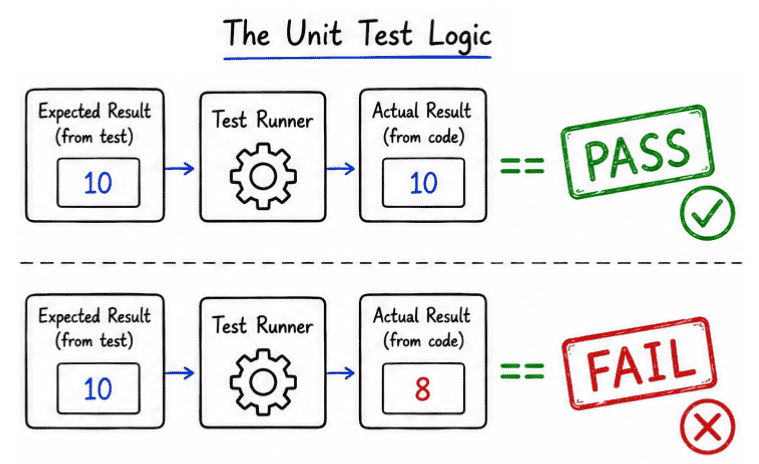
Compare expected result with actual result
👉 If expected == actual → Test PASSES
👉 If expected != actual → Test FAILS
Unit testing is widely used in modern software development to ensure code reliability and correctness.
Banking applications (transaction and security validation)
E-commerce systems (cart, payment, order logic)
REST APIs (request and response validation)
Spring Boot applications
Microservices architecture
Enterprise backend systems
Finds bugs early in the development phase
Improves overall code reliability
Makes code easier to maintain and update
Supports safe refactoring without breaking functionality
Improves development speed in the long term
Does not test the full system flow or end-to-end behavior.
Requires extra time and effort to write test cases.
Cannot detect integration issues between multiple modules alone.
JUnit is an essential part of Java development that ensures individual components of an application work correctly in isolation.
It improves code quality, reduces bugs, and makes applications more reliable and maintainable.
JUnit and TestNG are the most commonly used testing frameworks
Helps in early bug detection during development
Essential practice for professional Java backend development
👉 Unit testing is a key foundation for building stable and production-ready Java applications.
